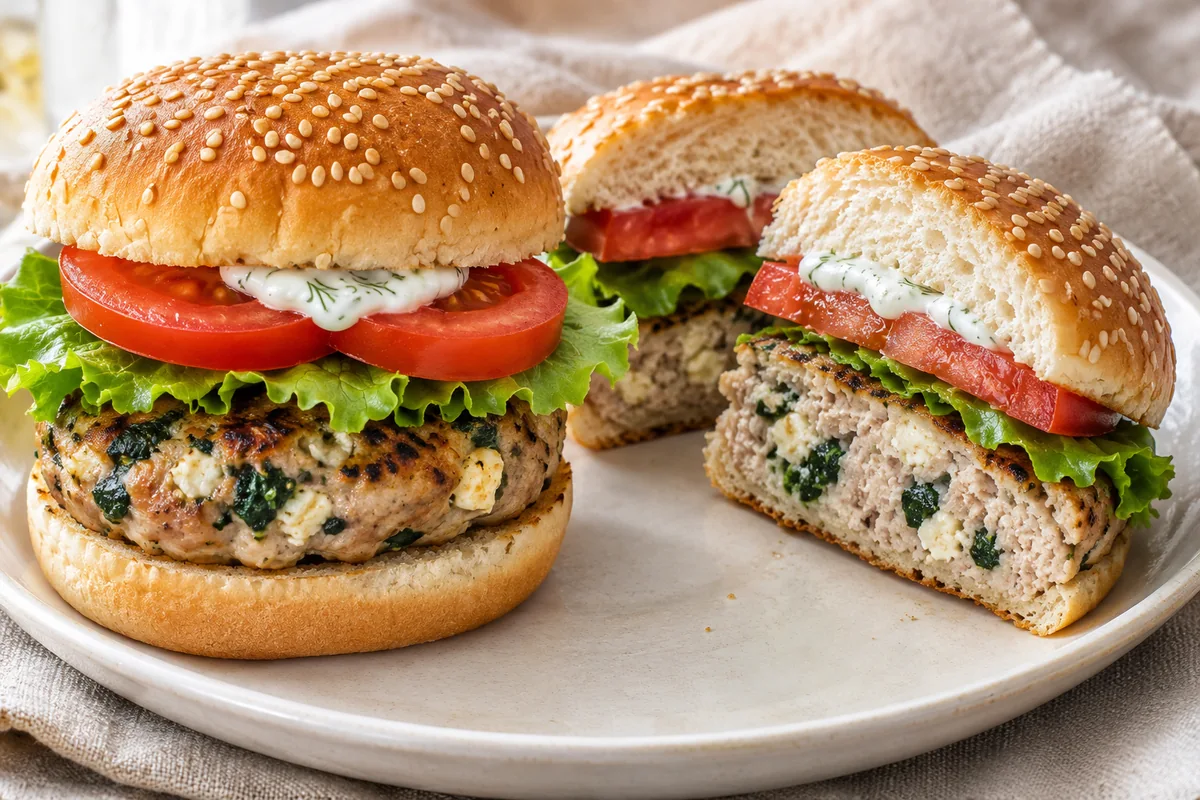
A turkey burger needs more than a handful of herbs to feel complete. Its patty should hold together when lifted, brown against the skillet, and stay tender enough to bite through without pushing the filling out of the bun. Spinach and feta help build that character: the greens bring an earthy note, while small cheese pockets interrupt the lean meat with salt and richness. Lemon zest and oregano keep the flavor distinct from a standard cheeseburger.
The important preparation happens before the turkey enters the bowl. Cook and squeeze the spinach, crumble the feta into small pieces, and have the crumbs ready. This keeps mixing brief and prevents wet greens from turning the mixture loose. A cool lemon-dill yogurt sauce supplies the final layer, with lettuce and tomato adding crunch and freshness instead of another heavy topping.
Recipe Summary
Equipment: 12-inch lidded skillet, mixing bowls, fine-mesh strainer, clean kitchen towel, broad spatula, and instant-read thermometer. Use medium and medium-low stovetop heat; no oven is required.
Ingredients
- 5 ounces fresh baby spinach
- 1 1/4 pounds 93% lean ground turkey
- 3 ounces feta cheese, finely crumbled
- 1/3 cup plain dry breadcrumbs
- 1 large egg, lightly beaten
- 2 scallions, finely chopped
- 2 garlic cloves, finely grated
- 1 teaspoon finely grated lemon zest
- 1 teaspoon dried oregano
- 1/2 teaspoon fine sea salt
- 1/2 teaspoon ground black pepper
- 2 tablespoons olive oil, divided
- 1/2 cup plain Greek yogurt
- 1 tablespoon fresh lemon juice
- 1 tablespoon chopped fresh dill
- 4 hamburger buns, split
- 4 large lettuce leaves, washed and dried
- 1 medium tomato, cut into 8 slices
How to Make the Burgers
- Put the 5 ounces spinach in the 12-inch skillet over medium heat. Stir for 2 to 3 minutes, until wilted. Transfer to a strainer, cool until comfortable to handle, then squeeze very firmly in a clean towel. Finely chop the squeezed greens. Wipe the skillet dry.
- Combine the 1 1/4 pounds turkey, chopped spinach, 3 ounces feta, 1/3 cup breadcrumbs, 1 beaten egg, 2 scallions, 2 garlic cloves, 1 teaspoon lemon zest, 1 teaspoon oregano, 1/2 teaspoon salt, and 1/2 teaspoon pepper in a bowl. Fold gently just until evenly distributed.
- Divide into 4 equal portions. Shape each into a patty about 4 inches wide and 3/4 inch thick, smoothing the edges without compressing the center. Set on a covered plate and refrigerate for 10 minutes while making the sauce.
- Stir the 1/2 cup Greek yogurt, 1 tablespoon lemon juice, and 1 tablespoon dill together in a small bowl. Cover and refrigerate until assembly. Keep this sauce and the vegetable toppings separate from raw turkey and its utensils.
- Heat 1 tablespoon of the olive oil in the dried skillet over medium heat. Add 2 patties and cook for 5 to 6 minutes, until browned underneath. Flip, reduce to medium-low, cover, and cook for 5 to 7 minutes more, until the centers reach 165 F. Transfer to a clean plate.
- Add the remaining 1 tablespoon olive oil and repeat with the remaining 2 patties, again cooking to 165 F. If needed, wipe away dark cheese residue between batches with the pan off the heat. Let the cooked patties stand for 3 minutes while preparing the buns.
- Place the 4 split buns cut-side down in the skillet in batches over medium-low heat for 30 to 60 seconds, until lightly toasted. Spread the yogurt sauce across all 4 buns. Add 1 lettuce leaf, 2 slices from the medium tomato, and 1 turkey patty to each bun, then close and serve.
What Keeps a Turkey Patty Together
Squeeze the spinach more than once
Wilted spinach can look compact while still holding a surprising amount of liquid. Press it in the strainer first, then wring it in the towel until firm pressure produces only a few drops. Chop after squeezing so that long stems cannot pull apart the patty as you bite. Let it cool before mixing with the raw meat; warm spinach makes the mixture harder to handle.
Frozen chopped spinach is a practical alternative. Replace the fresh greens with 1/3 cup firmly packed, thawed and thoroughly squeezed frozen spinach. That measurement refers to the dry, compressed greens, not the icy contents of the bag. Skip the wilting step, but still check for coarse stems and chop them. Extra wet spinach is the most likely reason these patties would slump before they reach the pan.
Use crumbs as support, not as the main ingredient
The breadcrumbs absorb a little moisture from the egg and turkey during the short chill. They are not meant to turn the burger into a bread-heavy meatloaf. Plain fine crumbs distribute more evenly here than large panko flakes. If panko is what you have, crush it lightly before measuring the same volume. For gluten-free burgers, use fine gluten-free crumbs and matching buns.
Mix with open fingers or a fork, lifting and folding rather than kneading. Stop when the green flecks and feta look reasonably even. Repeated squeezing creates a dense patty, especially with lean poultry. The short refrigeration period firms the fat and gives the crumbs time to hydrate, making a broad spatula much more effective than trying to lift a soft patty immediately.
Brown patiently, then finish under a lid
Medium heat gives the outside time to color before the center finishes. Feta touching the skillet may toast quickly, so a few dark gold spots are expected. A black ring around the patty means the heat is too high. Lower the burner and clear scorched cheese before the next batch so those bitter crumbs do not attach to fresh burgers.
The lid traps some heat after the flip, helping a thick poultry patty finish without repeatedly pressing it. Pressing forces juices into the pan and does not make cooking safer. Insert the thermometer horizontally through the side into the center; checking from above can accidentally put the sensor near the hot skillet rather than in the coolest part of the meat.
Feta, Turkey, and Sauce Options
Turkey labeled 93% lean has enough fat for a burger that still tastes like turkey rather than sausage. Extra-lean breast meat can be used in the same quantity, but it has less tolerance for prolonged cooking. Do not compensate by stopping below the safe temperature. Instead, measure accurately, keep the patties evenly thick, and remove them as soon as the center reaches the target.
A block of feta is easy to crumble into small, irregular pieces. Avoid leaving large cubes, which create weak pockets where the patty can split. A milder cheese such as finely crumbled goat cheese can replace the feta by weight, though it will melt more softly and taste less briny. If omitting cheese entirely, expect a less rich burger; extra salt alone cannot replace its texture.
Use thick Greek yogurt so the sauce stays on the bun. Regular plain yogurt can be strained in the refrigerator before measuring. Chopped mint can replace the dill tablespoon for tablespoon, giving a cooler, more pronounced herbal finish. Keep the lemon juice measured: a very thin sauce soaks into bread and makes even a well-shaped burger difficult to eat neatly.
Planning the Meal
Toast the buns lightly, not until brittle. A thin toasted surface resists the yogurt, while a hard crust encourages the patty to slide when bitten. Put the lettuce underneath the tomato so its dry leaf shields the bread from juices. Serve with roasted potato wedges or a cucumber salad rather than piling additional moist vegetables onto an already generous burger.
For another portioned turkey dinner that uses savory cheese, garlic Parmesan turkey meatloaf muffins are a useful change of format. If you are building a summer table around the burgers, Southern tomato pie with cheddar and basil can supply a contrasting tomato-centered side in smaller slices.
Make Ahead and Store Safely
Shape the raw patties up to one day ahead, cover, and refrigerate on a lower shelf. Prepare the yogurt sauce separately and slice the tomato shortly before serving. Cook turkey burgers to 165 F, as specified in the FoodSafety.gov temperature chart. Refrigerate cooked patties and sauce within 2 hours, or 1 hour when temperatures exceed 90 F, following the chilling guidance.
Store patties without buns or vegetables at 40 F or below for 3 to 4 days, consistent with the cold storage chart. Keep sauce separately and use within the same window. Reheat patties covered over low heat with a small splash of water until their centers reach 165 F, then assemble with fresh toppings. Stored assembled burgers become soggy long before the patties lose their usefulness.