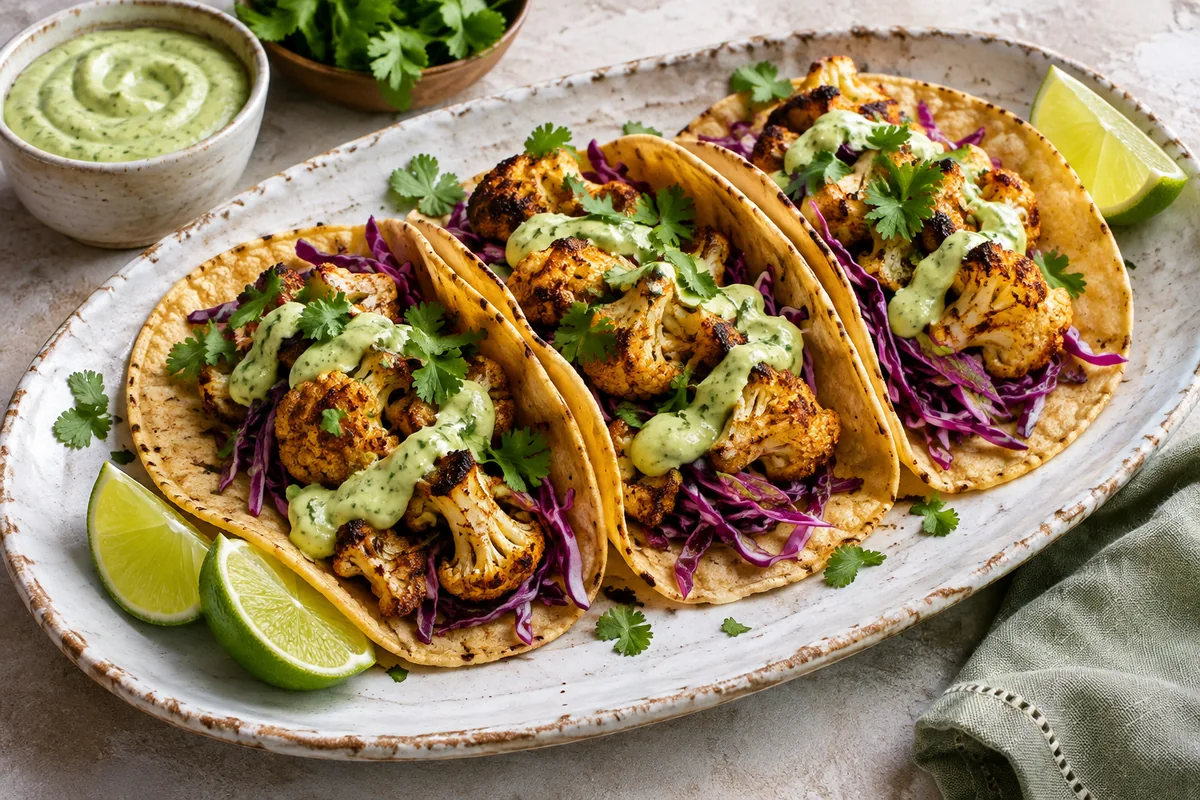
Cauliflower tacos work best when the filling has contrast, not when every component is soft. Here, small florets roast until their flat sides brown and their stems turn tender. A cool avocado lime crema clings to the cauliflower, while thin cabbage and radishes add the snap that roasted vegetables cannot provide alone. Warm corn tortillas bring the whole thing together without competing with the spices.
The seasoning leans on cumin, smoked paprika, and coriander rather than a heavy sauce. That keeps the roasting pan dry enough for browning and leaves the lime flavor to the cold components. These are vegetable-centered tacos, not an attempt to imitate meat. The goal is a generous filling with a nutty roasted flavor, a creamy finish, and enough freshness to make a second taco welcome.
Recipe details
Use a 13-by-18-inch rimmed metal sheet pan, a large bowl, a blender or small food processor, and a dry skillet for tortillas. Roast at 425 F on the middle rack. A second sheet pan is useful if your cauliflower will not fit in one uncrowded layer. Prepare the crema and cabbage during the roasting time.
Ingredients
- 1 1/2 pounds trimmed cauliflower florets, cut into 1 1/2-inch pieces (680 g)
- 2 tablespoons olive oil
- 1 teaspoon ground cumin
- 1 teaspoon smoked paprika
- 1/2 teaspoon garlic powder
- 1/2 teaspoon ground coriander
- 3/4 teaspoon fine salt, divided
- 1/4 teaspoon ground black pepper
- 1 ripe medium avocado, pitted and peeled (about 150 g flesh)
- 1/3 cup sour cream (80 g)
- 3 tablespoons fresh lime juice, divided
- 2 tablespoons water (30 ml)
- 2 cups thinly sliced red cabbage (140 g)
- 1/4 cup chopped fresh cilantro, divided
- 8 small corn tortillas, about 6 inches across
- 4 radishes, trimmed and thinly sliced
Cut the cauliflower to create browned surfaces
A whole cauliflower varies considerably in size, so weigh the trimmed florets rather than relying on one head as a fixed measure. Remove the leaves and woody base, then separate the curds into manageable pieces. Slice large florets through the stem to create at least one flat surface. Those cut faces make better contact with the pan than the rounded tips.
Keep the pieces close to the stated size. Tiny crumbs can burn before larger stems soften, and giant florets are awkward to eat in a small tortilla. If a stem is thick, split it lengthwise without reducing the whole floret to rubble. Dry the cauliflower after washing; water left between the branches makes steam just when the surface should be beginning to roast.
Use heat and space instead of extra oil
Two tablespoons of oil coat this amount of cauliflower without leaving a greasy tray. Toss the vegetables thoroughly so the spice mixture reaches the crevices. The oil helps the powdered spices adhere and encourages surface browning, but adding more cannot solve an overcrowded pan. Overlapping florets trap moisture and soften each other.
Spread the pieces so you can see some bare metal between them. A heavy, light-colored sheet pan gives a useful balance of browning and control. Dark pans can color the undersides faster, so check early. Parchment can simplify cleanup, but direct contact with lightly oiled vegetables on bare metal generally creates a more pronounced crust. Avoid a deep casserole dish, which holds steam around the cauliflower.
Roast, blend, and assemble
- Heat the oven to 425 F with a rack in the middle. Dry the cauliflower well and place it in a large bowl.
- Add the olive oil, cumin, smoked paprika, garlic powder, coriander, 1/2 teaspoon salt, and black pepper. Toss until evenly coated. Spread on a 13-by-18-inch rimmed metal sheet pan with flat cut sides against the pan and space between pieces.
- Roast for 25 to 30 minutes, turning the florets after 15 minutes, until the edges are browned and a knife slips easily into the stems. If the pan is crowded, divide between two pans and rotate their positions halfway through.
- While the cauliflower roasts, blend the avocado, sour cream, 2 tablespoons lime juice, water, and remaining 1/4 teaspoon salt until smooth. Scrape the sides as needed. Transfer the crema to a bowl, cover, and refrigerate until serving.
- Toss the cabbage with the remaining 1 tablespoon lime juice and 2 tablespoons of the cilantro. Let stand for 10 minutes, then toss again. Keep the radishes and remaining 2 tablespoons cilantro ready for assembly.
- During the last few minutes of roasting, warm the tortillas in a dry skillet over medium-high heat for 20 to 30 seconds per side, working in batches, until flexible and lightly spotted. Stack them in a clean kitchen towel to keep warm.
- Divide the cabbage and roasted cauliflower among the 8 warm tortillas. Spoon the crema evenly over the filling, then add the sliced radishes and remaining cilantro. Serve immediately, allowing 2 tacos per person.
Make a crema that coats rather than floods
Choose an avocado that yields gently near the stem but does not feel hollow or mushy. Firm fruit makes a grainy sauce even with a good blender. Sour cream lightens the avocado and adds acidity; the measured water helps the mixture circulate around the blades. Stop and scrape rather than pouring in large amounts of extra liquid.
The finished crema should fall from a spoon in a thick ribbon, not run like a vinaigrette. The lime juice provides brightness and slows browning, but it does not preserve avocado indefinitely. Keep the bowl covered and cold until assembly. A small processor often handles this quantity better than a full-size blender with a very wide base.
Balance crunch, acidity, and tortilla strength
The cabbage receives only lime and cilantro because the crema supplies the richness. Ten minutes of contact softens the toughest cut edges while leaving the shreds crisp. Slice across the cabbage into fine strands and shorten any very long ones; thick ribbons can pull the filling out when you bite. If liquid gathers in the bowl, lift the cabbage out rather than tipping everything into the tacos.
Radishes go on last to preserve their fresh crunch. Their mild peppery flavor is particularly useful against the sweet, browned cauliflower. Cilantro is divided between the slaw and the finish so its flavor runs through the filling rather than sitting in one large leafy mouthful. Assemble just before eating, since even a carefully made taco softens as its warm and cold components sit together.
Prevent broken tortillas and bland florets
Cold corn tortillas often crack at the fold. Warm them until pliable, not until dry and brittle, then hold them in a towel. If a package contains very thin tortillas, a second tortilla underneath can add support, but that requires buying more than the eight listed. Keep the base recipe modestly filled so one tortilla can carry each serving.
If the cauliflower tastes flat, check whether the spices were left in the bottom of the mixing bowl. Scrape the seasoned oil over the florets before roasting. Pale vegetables need more browning, not automatically more salt. If the outer branches darken before the stems soften, the pieces are too large or the oven runs hot; split thick pieces and finish roasting, watching the edges closely.
Substitutions with practical limits
For a dairy-free and vegan version, replace the sour cream with the same volume of plain, unsweetened thick plant-based yogurt. Avoid vanilla yogurt and thin drinkable products, which change the flavor or make the crema runny. Thick plain Greek yogurt also works for a tangier dairy version, though its flavor is sharper than sour cream.
Green cabbage can replace red cabbage by volume and stays similarly crisp. Parsley can replace cilantro if needed, but use it with the expectation of a different herb profile. Flour tortillas work if corn is not preferred; choose small ones and warm them briefly. For a gluten-free meal, verify the corn tortilla label and spice packaging rather than assuming every packaged product is suitable.
Store components, not assembled tacos
Refrigerate perishable components within 2 hours, or 1 hour above 90 F. Store roasted cauliflower at 40 F or below for 3 to 4 days, using the FoodSafety.gov cold-storage chart for general leftover guidance. Keep crema separately with covering pressed against its surface and use within 2 days; the dressed cabbage is best within 2 days for texture.
Reheat cauliflower on a sheet pan at 400 F until hot and its center reaches 165 F, following the FoodSafety.gov leftover temperature guidance. Leave the crema and slaw cold. Freezing roasted cauliflower is possible, but thawed florets become softer, so a freshly roasted batch is preferable when browned texture is the main attraction.
Serving ideas for a taco table
For another example of crisp filling against fresh cabbage, crispy fish tacos with lime slaw uses the same contrast with a different main ingredient. It can serve as a separate option for a mixed-diet gathering without changing these vegetarian tacos.
For a meatless summer spread beyond tacos, southern tomato pie with cheddar and basil brings a rich, sliceable counterpart. Keep additional sides simple so the smoky cauliflower, cool crema, and crunchy vegetables remain the clear center of the plate.