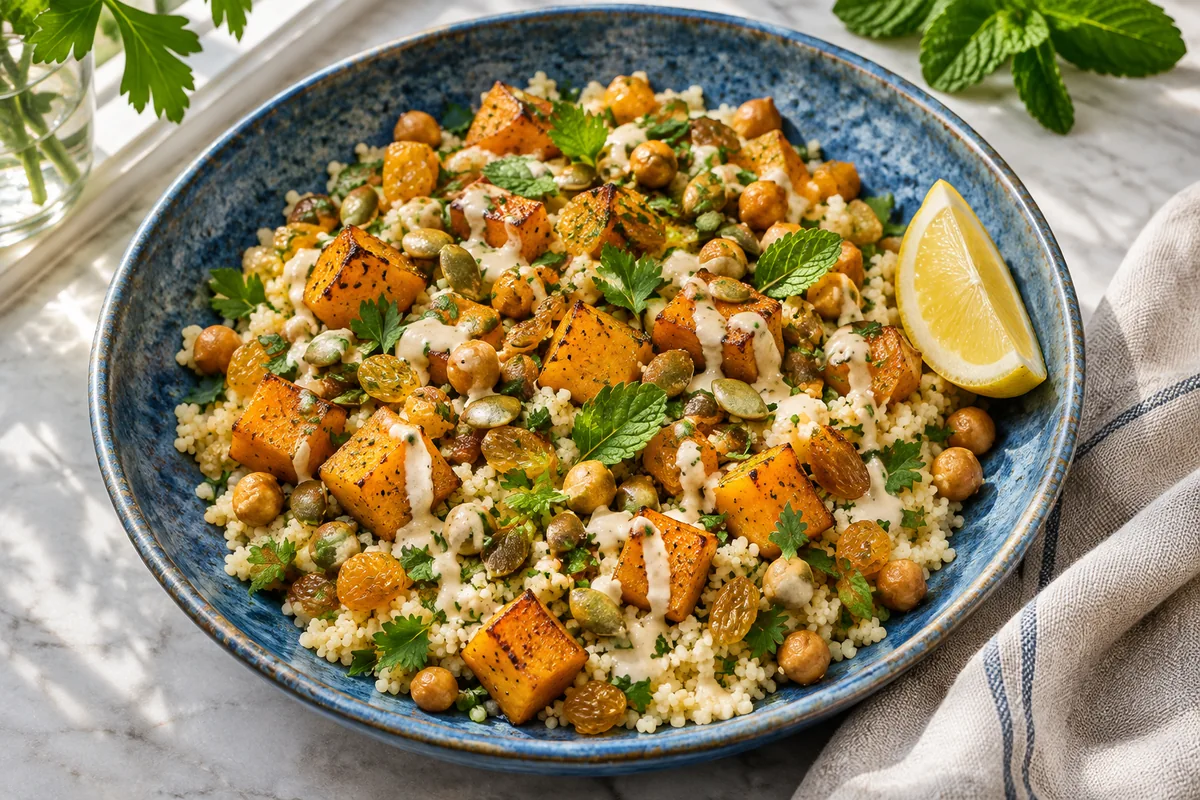
Roasted butternut squash and chickpea couscous works because its ingredients do not all have the same texture. The squash brings soft, sweet centers and browned corners. Chickpeas offer a firmer bite, couscous supplies a light grain base, and toasted pumpkin seeds finish each bowl with crunch. A lemon-tahini dressing adds a slightly bitter, nutty counterpoint, so the sweetness of the squash never takes over the whole meal.
Cumin warms in the oil around the squash, while smoked paprika joins the chickpeas later to limit scorching. Raisins plump directly in the couscous. Each component gets the treatment it needs without adding another pan.
Recipe Summary
Equipment: 18-by-13-inch rimmed sheet pan, oven-safe parchment, small lidded saucepan, wide serving bowl, flexible spatula, fork, and whisk. Oven: 425 F, middle rack. Use regular fine couscous, not pearl couscous.
Ingredients
- 2 pounds peeled, seeded butternut squash, cut into 3/4-inch cubes
- 3 tablespoons olive oil, divided
- 1 teaspoon fine sea salt, divided
- 1/2 teaspoon ground black pepper, divided
- 1 teaspoon ground cumin
- 1/2 teaspoon smoked paprika
- 1 can (15 ounces) chickpeas, drained, rinsed, and dried, about 1 1/2 cups
- 1 cup dry regular couscous
- 1 cup low-sodium vegetable broth
- 1/4 cup golden raisins
- 3 tablespoons well-stirred tahini
- 2 tablespoons fresh lemon juice
- 3 tablespoons warm water
- 1 teaspoon finely grated lemon zest
- 1/4 cup chopped flat-leaf parsley
- 2 tablespoons chopped fresh mint
- 1/4 cup toasted hulled pumpkin seeds
Roast, Steam, and Assemble
- Heat the oven to 425 F with a rack in the middle. Line an 18-by-13-inch rimmed sheet pan with parchment rated for this temperature. Toss the 2 pounds squash cubes with 2 tablespoons of the olive oil, 1/2 teaspoon of the salt, 1/4 teaspoon of the pepper, and the 1 teaspoon cumin. Spread in one layer and roast for 15 minutes.
- Turn the squash with a spatula. Add the drained, rinsed, and thoroughly dried chickpeas from the 15-ounce can, about 1 1/2 cups, and sprinkle with the 1/2 teaspoon smoked paprika, 1/4 teaspoon of the salt, and remaining 1/4 teaspoon pepper. Toss gently with the squash and its oil. Roast for 18 to 20 minutes more, until the squash is tender with browned corners and the chickpeas have dry, lightly toasted edges.
- During the final 10 minutes of roasting, bring the 1 cup vegetable broth and remaining 1/4 teaspoon salt to a boil in a small lidded saucepan. Stir in the 1 cup dry regular couscous and 1/4 cup golden raisins. Remove from the heat, cover, and leave undisturbed for 5 minutes.
- Uncover the couscous and drizzle with the remaining 1 tablespoon olive oil. Fluff gently with a fork, lifting from the bottom to separate the grains and distribute the plumped raisins. Transfer to a wide serving bowl.
- Whisk the 3 tablespoons tahini and 2 tablespoons lemon juice together in a small bowl. Add the 3 tablespoons warm water gradually, whisking until smooth and pourable, then stir in the 1 teaspoon lemon zest.
- Fold the roasted squash and chickpeas into the couscous with the 1/4 cup parsley and 2 tablespoons mint, taking care not to crush the squash. Divide among 4 bowls, drizzle all the tahini dressing evenly over the servings, and scatter with the 1/4 cup toasted pumpkin seeds.
Give the Squash Room to Brown
Measure the prepared squash, not the whole vegetable
The two-pound quantity means peeled and seeded flesh. A whole squash may need to weigh about three pounds to supply that much, but the exact yield depends on its seed cavity and peel. Trim the ends, separate the narrow neck from the bulb, and peel each section before cutting. A sturdy vegetable peeler and a stable cutting board make the rounded bulb easier to manage than trying to shave it while it rolls.
Keep the cubes close to three-quarter inch. Tiny pieces soften early and can dissolve when folded through the couscous; large chunks may look browned while their centers are still firm. Precut squash is convenient, but check its size and trim oversized pieces. Pat away moisture from the package so the oil and cumin coat the surface instead of sliding into the bottom of the pan.
Leave space for evaporation
The squash should occupy a single layer before the chickpeas arrive. If your tray is smaller than the specified size, use two pans and rotate their positions during roasting. Crowding traps moisture and produces pale, steamed cubes. Browning is not just cosmetic here: it gives the squash a savory edge that balances its natural sweetness and the raisins.
Turn with a thin spatula rather than stirring aggressively. Once a cube has a browned face, lift it from underneath and roll it onto another side. The chickpeas do not need to become crunchy all the way through. Their role is a lightly toasted exterior around a tender center; attempting snack-level crispness on the same tray would usually overcook the squash.
Couscous That Stays Light
Use the correct grain and hydration method
Regular couscous consists of very small semolina granules that hydrate quickly off the heat. Pearl couscous is larger and requires a different cooking process, usually an active simmer. Do not swap it into the same five-minute covered rest. For this recipe, choose a regular couscous whose package supports a one-to-one liquid ratio; if its directions specify otherwise, follow the package liquid requirement.
Once the broth boils and the couscous goes in, cover immediately and leave it alone. Lifting the lid repeatedly releases the steam needed for even hydration. After resting, use a fork to lift and separate rather than flattening the grains with a spoon. The finishing oil helps them move freely when the heavier vegetables are added.
For dry, chalky patches, sprinkle on a tablespoon of hot water, cover, and wait a few minutes. Wet couscous needs a brief uncovered rest before fluffing. Add vegetables only once the grains separate easily; dressing cannot fix sogginess.
Tahini Dressing and Ingredient Replacements
Stir the tahini in its jar before measuring because the oil often separates from the sesame solids. Lemon juice may initially make it seize into a thick paste. This is normal: the measured warm water loosens it as you whisk. Add the water gradually so you can break up the thickened center instead of chasing small lumps around a thin liquid.
For a sesame-free variation, replace the tahini with three tablespoons smooth sunflower seed butter, checking the label for cross-contact information when relevant. Its flavor is different but still suits the squash. If it is sweetened or salted, adjust the finished dressing cautiously. For an alternative without seed butter, use an equal volume of plain yogurt and reduce the added water to a small splash.
Acorn squash or peeled sweet potato can replace the butternut by prepared weight. Both should be cut to the same size, but start checking early because their moisture and starch differ. Cannellini beans can replace the chickpeas by drained volume; fold them onto the tray gently and expect a softer bean, not the same slightly chewy bite.
Raisins are a deliberate sweet accent, not a requirement for structure. Replace the quarter cup with chopped dried apricots if you prefer a less concentrated burst in each bite. For a gluten-free version, use cooked quinoa in place of the couscous, preparing it separately according to its package. Wheat couscous itself is not gluten-free, even though its small shape can resemble other grains.
Serving and Making Components Ahead
This bowl can stand on its own as a vegetarian main, and the written ingredients are also vegan. Serve the dressing in visible ribbons rather than stirring every drop through the grains; that preserves contrasts between bright lemon, toasted chickpeas, and sweet squash. Add the pumpkin seeds at the table, where they will stay crisp instead of absorbing steam from the vegetables.
If you want another dinner built around beans and vegetables, creamy Tuscan white bean soup offers a spoonable change of pace. For a vegetable-centered baked meal with a different texture, Southern tomato pie with cheddar and basil trades the couscous bowl for a savory tomato filling and cheddar topping.
For advance preparation, cube the squash and mix the dressing the day before, refrigerating them separately. Roast the vegetables while the couscous steams shortly before dinner. You can also prepare the complete grain-and-vegetable base ahead, but keep the dressing, herbs, and seeds separate until serving so the fresh and crunchy elements retain their character.
Cooling and Leftover Bowls
Do not leave cooked couscous on the counter to cool for an extended period. Spread leftovers in shallow containers and refrigerate within 2 hours, or within 1 hour when the temperature exceeds 90 F, following FoodSafety.gov chilling guidance. At 40 F or below, plan to eat this cooked meal within 3 to 4 days; consult the cold storage chart for storage guidance.
Reheat the grain and vegetable base covered with a small splash of water, stirring partway through, until it reaches 165 F under the leftover temperature guidance. Add separately stored dressing, herbs, and seeds afterward. The squash will be softer on reheating, so fold gently rather than repeatedly stirring the cubes into the couscous.