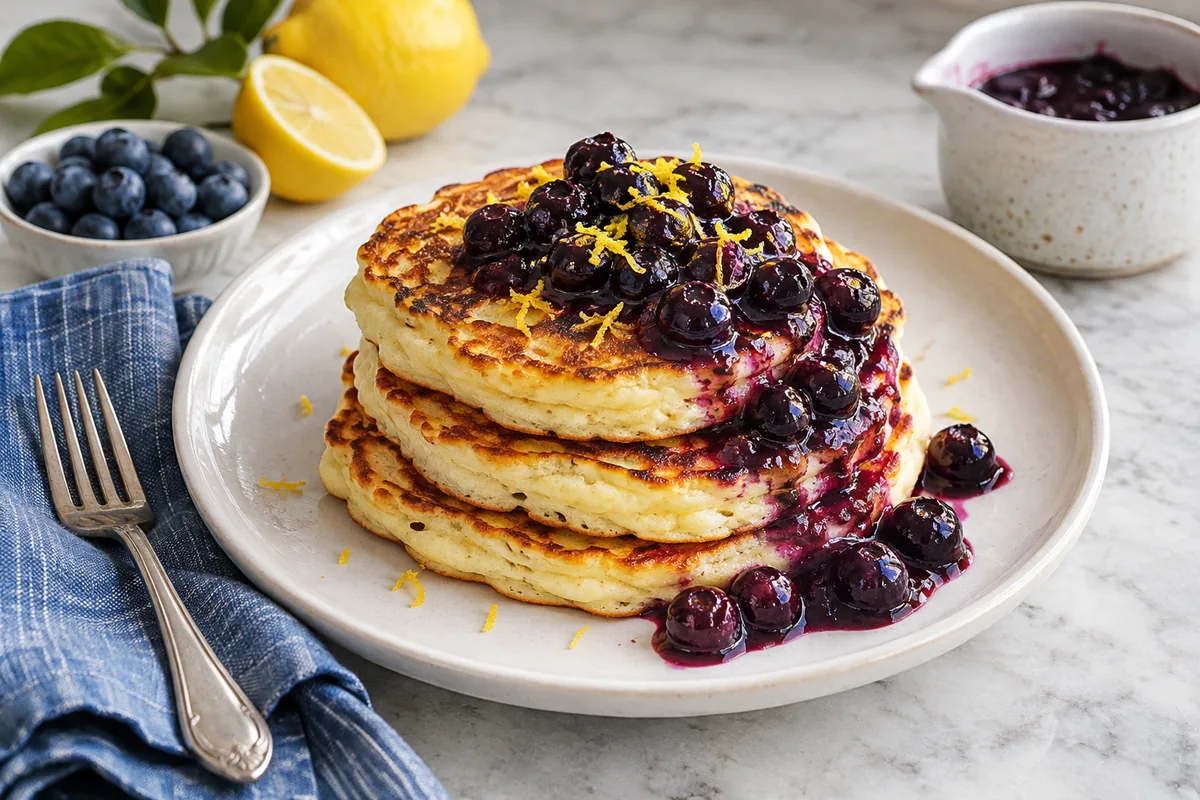
Lemon ricotta pancakes have a softer, more delicate center than a plain diner-style pancake. Ricotta contributes moisture and small creamy curds, while lemon zest carries citrus flavor without requiring enough juice to thin the batter excessively. They should be tender and lightly springy, not dry inside or wet beneath a browned surface.
The blueberry compote provides the contrast that makes the plate complete. Some berries burst into a purple sauce while others retain their shape, giving each forkful both fruit and juice. A small amount of cornstarch keeps that juice on the pancakes rather than letting it run straight to the bottom of the plate.
Breakfast Timing and Cookware
Use a 2-quart saucepan, two mixing bowls, a flexible spatula, a quarter-cup measure, and a 12-inch nonstick skillet. A thin turning spatula is helpful because these pancakes are delicate before their second side cooks. Have a thin-probe thermometer available. The batter's 10-minute rest fits into the preparation window; the compote cooks while you organize and mix the pancake ingredients.
Ingredients for Pancakes and Compote
- 2 cups blueberries (about 300 grams), fresh or frozen
- 5 tablespoons granulated sugar, divided
- 3 tablespoons fresh lemon juice, divided
- 3 tablespoons water, divided
- 1 teaspoon cornstarch
- 1 1/4 cups all-purpose flour (150 grams)
- 1 1/2 teaspoons baking powder
- 1/4 teaspoon fine salt
- 2 large eggs
- 1 cup whole-milk ricotta cheese (about 245 grams), drained of visible pooled whey
- 3/4 cup whole milk
- 1 tablespoon finely grated lemon zest
- 1 teaspoon vanilla extract
- 3 tablespoons unsalted butter, melted and cooled slightly, divided
What Makes the Centers Tender
Ricotta Moisture Matters More Than Perfectly Smooth Batter
Whole-milk ricotta gives the most rounded flavor and a supple texture. Open the container and pour off any obvious whey gathered at the top. If the cheese sits in a puddle, let it drain briefly in a fine-mesh sieve before measuring. Do not squeeze it dry, since the recipe depends on its natural moisture.
A few visible curds are expected. Trying to eliminate every bump by beating the finished batter develops the flour's gluten and works against tenderness. Whisk the wet ingredients well enough to distribute the cheese, then fold wet into dry only until the last flour streak disappears. The batter should fall from the measure in a thick ribbon rather than pour like milk.
Zest Brings Fragrance Without Extra Liquid
Grate only the yellow surface of the lemon, rotating it as soon as white pith appears. That colored layer holds fragrant oils; the pith adds bitterness without much citrus aroma. Measure the zest loosely rather than packing it down. Juice is divided between the batter and berries, where its acidity balances sugar in two different ways.
The baking powder supplies reliable lift without depending entirely on the acidity of a particular lemon. Use fresh baking powder and measure it level. Resting the mixed batter gives the flour time to hydrate, so the first batch is less likely to spread into thin, uneven disks. It is a short rest, not an overnight batter.
Numbered Cooking Method
- Place the blueberries, 2 tablespoons of the sugar, 1 tablespoon of the lemon juice, and 2 tablespoons of the water in a 2-quart saucepan. Bring to a simmer over medium heat, then cook for 5 to 7 minutes, stirring occasionally, until some berries burst and the juices collect. Whisk the cornstarch with the remaining 1 tablespoon water in a small cup, stir into the berries, and simmer for 1 minute. Remove from the heat and cover loosely.
- Whisk the flour, baking powder, salt, and remaining 3 tablespoons sugar in a large bowl. In another bowl, whisk the eggs, ricotta, milk, lemon zest, vanilla, remaining 2 tablespoons lemon juice, and 2 tablespoons of the melted butter until evenly combined; small ricotta curds are fine.
- Pour the wet mixture into the dry mixture. Fold gently with a spatula just until no dry flour remains, without beating smooth. Rest the batter for 10 minutes while the skillet heats. If holding cooked pancakes, heat the oven to 200°F and place a wire rack on a rimmed sheet pan inside.
- Heat a 12-inch nonstick skillet over medium-low heat for about 3 minutes. Brush with a little of the remaining 1 tablespoon melted butter, reserving the rest for later batches. Divide the batter into 12 pancakes, using approximately 1/4 cup per pancake and adjusting the final portions as needed. Cook 3 at a time, allowing room to turn them.
- Cook each batch for 2 to 3 minutes on the first side, until the edges look set, the underside is golden, and a few bubbles hold open on top. Flip gently and cook for 2 minutes more, until the centers spring back lightly and no wet batter remains. Check a thick pancake from the side with a thin instant-read probe; its center should reach at least 160°F. Lower the heat if the exterior browns before the middle sets.
- Transfer cooked pancakes to the oven rack in a single layer, if needed, while cooking the remaining batches with the reserved butter. Avoid stacking them during holding and serve within about 20 minutes. Stir the compote, then serve 3 pancakes per person with one-quarter of the compote.
Manage the Griddle for Golden, Fully Set Pancakes
Moderate Heat Beats a Dark Crust and Raw Middle
Ricotta batter browns readily because it contains milk, cheese, butter, and sugar. Start at medium-low rather than the heat you might use for a leaner pancake. A small dab of batter should sizzle gently when it lands. If butter turns dark almost immediately, remove the skillet from the heat briefly and lower the burner before proceeding.
Keep each pancake modest in size. An oversized disk can brown at the edges while its moist center remains undercooked. Bubbles are one cue, not the only cue: ricotta batter sometimes shows fewer bubbles than plain batter. Look for edges that lose their wet shine and an underside firm enough to lift in one piece.
Slide the spatula fully underneath before turning, and flip once. Pressing down with the spatula squeezes out moisture and compresses the developing crumb. Because the batter contains raw egg and flour, do not taste it uncooked. The center should be set and reach at least 160°F; the FoodSafety.gov temperature chart lists 160°F for egg dishes.
Keep Earlier Batches Dry on the Outside
A wire rack in a low oven lets steam escape underneath the cooked pancakes. A plate traps that steam, and a tall stack makes the bottom pancakes damp and dense. Hold them briefly in one layer, then assemble the serving stacks just before the compote goes on. If using a larger griddle, you may finish faster than the skillet schedule.
Stir the compote before serving because the fruit and juice can settle while it stands. It should look glossy and spoonable, with a loose trail falling from the spoon. If it becomes too thick, stir in water one teaspoon at a time. If it is thin, simmer briefly after the slurry has been added; cornstarch needs that final simmer to thicken properly.
Substitutions and Troubleshooting
Part-skim ricotta works but can make a slightly less rich pancake. Cottage cheese is not a direct equivalent unless blended and carefully drained; its larger curds and variable liquid content change the batter. Keep the original ricotta measurement for the most predictable result. A cup-for-cup gluten-free flour blend may work, but avoid substituting almond flour alone because it lacks the same structure.
If the batter is unusually stiff after resting, fold in milk one tablespoon at a time until scoopable. Very well-drained ricotta can require that adjustment. If it spreads too quickly, give it another few minutes to hydrate before adding anything. Check your flour measurement as well: scooping a packed cup from the bag can add enough excess flour to make the pancakes heavy.
For the compote, fresh and frozen blueberries are interchangeable by weight. Frozen berries often produce a darker, more uniform sauce, while fresh berries can retain more individual shape. Raspberries make a tangier, seedier topping and break down much faster, so shorten their simmer rather than following the blueberry timing mechanically.
Make Brunch Ahead Without Flat Pancakes
Make the compote a day ahead and refrigerate it separately. Whisk the dry ingredients together the night before, but keep the wet mixture covered in the refrigerator until morning. Combine and rest just before cooking. Cold ingredients may need an extra minute on the skillet, so rely on doneness cues and temperature rather than increasing the burner sharply.
For another lemon-and-berry centerpiece, lemon blueberry cream cheese coffee cake moves those flavors into a sliceable bake. A brunch spread that needs a contrasting, nutty option can include brown butter pecan banana bread, served in small slices alongside the pancakes rather than as another large portion.
Refrigerate pancakes and compote separately within 2 hours, or within 1 hour above 90°F. Keep them at 40°F or below and use within 3 to 4 days. Freeze pancakes individually before packing together for up to 2 months for quality. Reheat refrigerated or thawed pancakes to 165°F, checking the centers; warm the compote to 165°F too, then spoon it over immediately before serving.