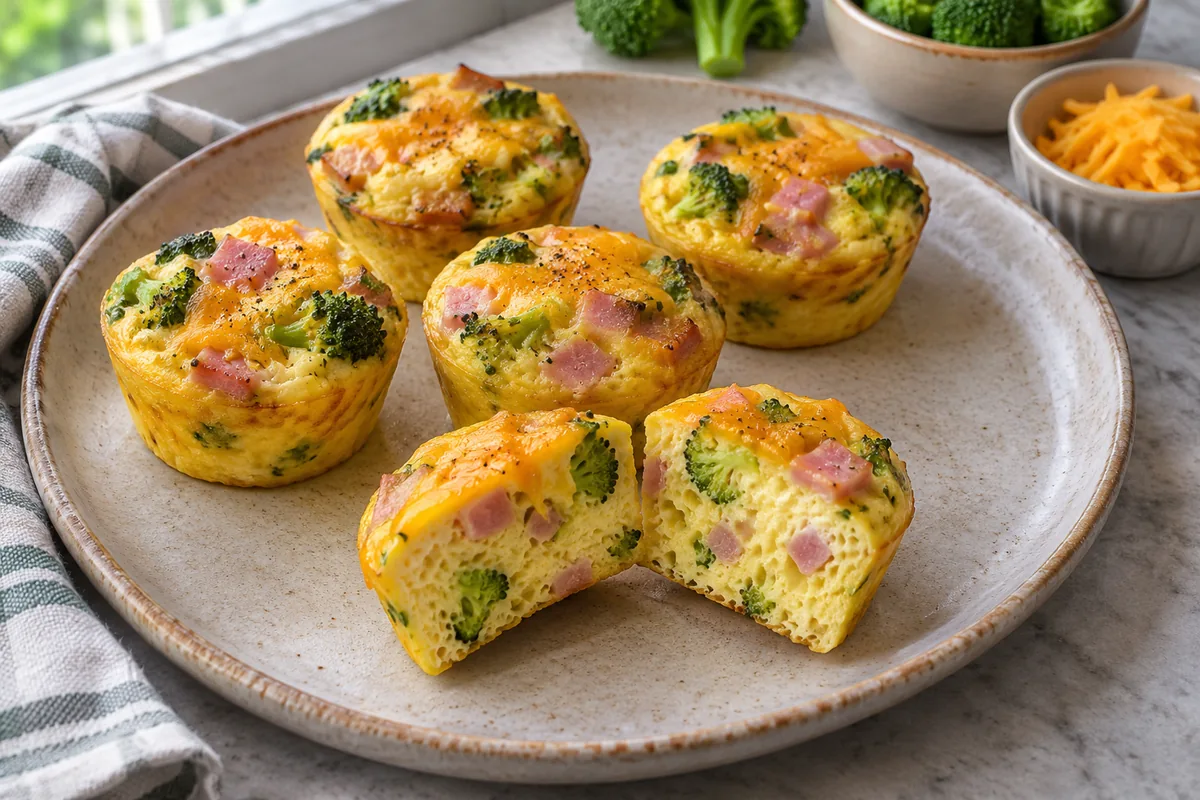
Good egg bites should taste like eggs and their fillings, not like a rubbery omelet compressed into a muffin cup. These pair salty ham, sharp cheddar, and finely chopped broccoli with a blended cottage-cheese base. The cheese softens the texture without requiring heavy cream, and the small vegetable pieces distribute evenly enough that each bite contains a little of everything.
A standard metal muffin pan makes twelve modest portions, with two egg bites forming one serving. There is no countertop pressure cooker or water bath involved. Instead, a moderate oven and careful attention to doneness keep the edges from toughening before the middle cooks. Preparing the broccoli separately is the other important step: raw florets release water in the cups and can remain unpleasantly firm.
Timing and equipment
Total time includes a 5-minute rest; cooking allows 3 minutes for broccoli and 22 minutes for baking. Use a standard 12-cup nonstick metal muffin pan with approximately 1/2-cup wells, a microwave-safe bowl and vented cover, a blender, and an instant-read thermometer. The oven temperature is 325 F. Mini muffin pans need different portioning and timing.
Ingredients
- 1 tablespoon olive oil, for greasing the muffin pan
- 1 cup finely chopped raw broccoli florets (100 g)
- 1 tablespoon water
- 8 large eggs
- 1/2 cup full-fat cottage cheese (115 g)
- 1/4 cup whole milk (60 ml)
- 1 teaspoon Dijon mustard
- 1/4 teaspoon fine salt
- 1/4 teaspoon ground black pepper
- 3 ounces fully cooked ham, cut into 1/4-inch dice (about 1/2 cup)
- 3 ounces sharp cheddar, freshly shredded (about 3/4 cup)
- 1 tablespoon finely chopped fresh chives
Build the base before adding the fillings
Cottage cheese supplies milk solids and moisture that soften the eggs' set. Blending removes most of its curds, so the finished bites do not have obvious white lumps. Choose plain full-fat cottage cheese rather than a flavored variety. Some brands are wetter than others; if there is a distinct puddle of whey on top, stir the container before measuring rather than scooping only liquid.
The milk loosens this base enough to flow around the ham and broccoli. More is not better. Extra milk can leave liquid weeping from the cooked bites, especially after refrigeration. Blend only until smooth and uniform, then stop. A prolonged blend introduces foam, which encourages a dramatic rise followed by a hollow, wrinkled collapse as the bites cool.
Keep broccoli tender and ham pieces small
Chop florets into pieces roughly the size of peas, trimming away any woody stem. A few short, thin pieces of tender stalk are fine. Microwave steaming takes the raw edge off without soaking the broccoli in a pot of water. Spread the cooked pieces on a clean towel, let steam escape, then blot them thoroughly. They should feel damp, not drip when pressed.
Use ham labeled fully cooked or ready to eat, not fresh uncooked ham. Thick deli slices or a small piece of cooked ham can both be diced neatly. Small cubes distribute more predictably than broad folded slices. Pat away surface moisture, especially on packaged diced ham. The salt quantity is deliberately restrained because both the ham and the cheddar contribute substantial seasoning.
Numbered method
- Heat the oven to 325 F with a rack in the center. Brush the bottoms and sides of all 12 wells of a standard nonstick metal muffin pan with the olive oil.
- Place the chopped broccoli and water in a microwave-safe bowl. Cover with a vented lid and microwave on high for 2 to 3 minutes, until just tender. Drain, spread on a clean towel to release steam, and blot dry. Let cool until no longer hot.
- Blend the eggs, cottage cheese, milk, Dijon mustard, salt, and pepper just until smooth, about 20 to 30 seconds. Let any foam settle while preparing the fillings.
- Pat the diced ham dry. Divide the ham, cooled broccoli, shredded cheddar, and chives evenly among the 12 greased wells.
- Pour the egg mixture evenly over the fillings, filling the wells approximately three-quarters full. Stir each well gently with a small spoon to distribute the fillings without scraping away the oil.
- Bake for 20 to 22 minutes, until the centers are set and the center of several egg bites reaches 165 F. Check without touching the pan with the thermometer; bake a few minutes longer if needed.
- Rest in the pan for 5 minutes. Loosen the edges with a silicone spatula, lift out carefully, and serve 2 egg bites per person.
A gentle bake still needs a temperature check
Watch for set centers rather than heavily browned tops. A little puffing is normal, but a tall dome is not the goal. Because these bites contain ham, this recipe uses a 165 F endpoint rather than stopping at the basic 160 F egg-dish minimum. Both categories appear on the FoodSafety.gov safe-temperature chart. Check multiple cups because muffin pans do not always heat evenly.
A narrow thermometer probe can enter at an angle into the middle of a bite. Avoid pushing through to the hot metal underneath, which gives an artificially high reading. Once the temperature is reached, remove the pan promptly. The five-minute rest helps the bites release, but leaving them in the warm pan for half an hour continues cooking their edges and traps condensation beneath them.
Diagnose common muffin-pan problems
If the bites stick, the usual causes are incomplete greasing, a worn nonstick coating, or trying to remove them immediately. Brush the vertical sides as well as the bottoms, particularly the corners where the two meet. Standard paper cupcake liners often cling to eggs and peel away a substantial part of breakfast. A flexible silicone spatula is gentler than a knife on the pan's coating.
Liquid around the bottom after chilling usually comes from wet broccoli, excess dairy, or overcooked eggs squeezing out moisture. Blot the vegetables rather than simply draining them. Measure milk in a liquid cup, and do not interpret browning as necessary doneness. If the texture is already firm, extended reheating will not dry the liquid away without making the eggs tougher.
Uneven filling can make some cups mostly ham and others mostly egg. Dividing the solid ingredients first avoids that problem. If one well looks crowded, move a little filling to a neighboring cup before pouring. Do not pack the broccoli tightly: the egg base needs space to reach the bottom and bind the pieces together.
Substitutions that keep the proportions intact
Swiss or Monterey Jack can replace the cheddar by weight. Swiss tastes nuttier and less sharp; Monterey Jack melts smoothly and produces a milder bite. For broccoli, use the same prepared volume of cooked, well-squeezed chopped spinach, distributing it loosely. Frozen broccoli should be thawed, chopped, and thoroughly dried before measuring 1 cup; it needs only enough steaming to become tender.
For a meatless version, replace the ham with 1/2 cup cooked, finely diced mushrooms that have been sauteed until their liquid evaporates. The flavor becomes earthier and less salty. Keep the dairy base unchanged. Replacing whole eggs with an equal volume of whites is a larger change: the missing yolk fat produces a firmer texture, so it is not an identical substitution.
Prepare ahead without sacrificing softness
Steam and dry the broccoli, shred the cheese, and dice the ham up to a day ahead; refrigerate them separately. Blend the egg base shortly before baking for the most even consistency. Baking a full batch ahead also works well. Refrigerate in shallow containers within 2 hours, or within 1 hour above 90 F, and keep at 40 F or below.
Use refrigerated egg bites within 3 to 4 days, consistent with the FoodSafety.gov storage chart. Freeze cooled bites individually, then bag them for up to 2 months for quality. Thaw overnight in the refrigerator. Reheat under a vented cover at medium microwave power in short intervals until the center reaches 165 F, rotating the plate for even heating.
Serving a small breakfast or a larger brunch
Two bites make a convenient breakfast alongside toast or fruit. For a larger hot spread, cheesy sausage, egg, and hash brown breakfast casserole offers a hearty alternative with potatoes. Serve the dishes as choices rather than assuming everyone needs a full portion of both egg-based recipes.
If the table needs a sweet counterpoint, blackberry cobbler French toast bake brings fruit and a softer bread-based texture. Keep the egg bites on a modest platter and replenish from properly held portions instead of leaving the entire batch out through a long brunch.