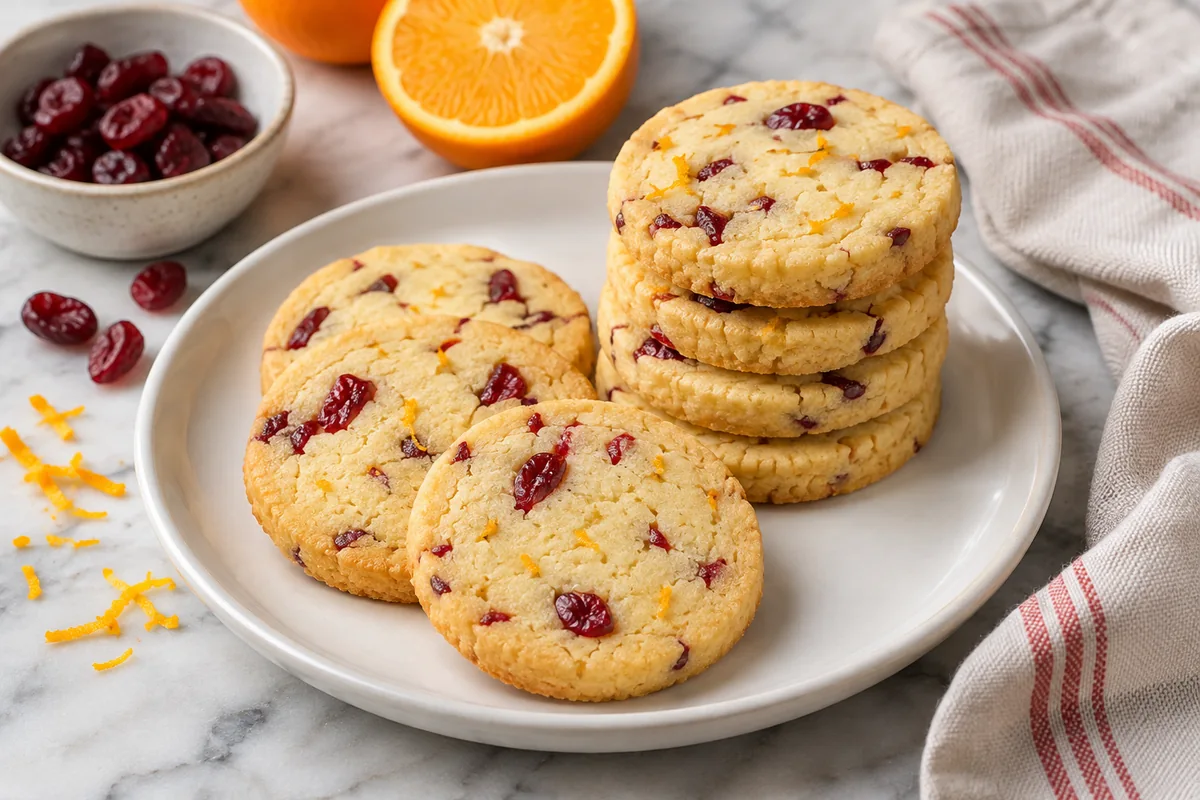
Orange zest changes the character of a simple butter cookie without adding the moisture of orange juice. Here it perfumes a restrained shortbread dough, while small pieces of dried cranberry supply a chewy, tart-sweet contrast. The result is a slice-and-bake cookie with a fine, sandy bite, enough structure for a cookie tin, and a flavor that does not need icing.
This dough is shaped into two manageable logs rather than rolled into a sheet. That keeps the flour on the counter out of the formula and makes the portions consistent. The important pauses are the refrigerator rest before slicing and the cooling time after baking; both matter as much as the mixing.
Recipe at a Glance
Total time includes 60 minutes of chilling and 20 minutes of cooling. Heat the oven to 325 F; baking may take 20 to 24 minutes depending on the oven.
Use a hand mixer, a large mixing bowl, a flexible spatula, parchment, a sharp nonserrated knife, two 13-by-18-inch rimmed baking sheets, and wire racks. The schedule assumes both sheets bake together; if your oven accommodates only one sheet, allow another baking cycle and keep the second batch refrigerated until its turn.
Ingredients
- 1 cup (226 g) unsalted butter, softened to cool room temperature
- 1/2 cup (100 g) granulated sugar
- 1 tablespoon finely grated orange zest, from about 2 medium oranges
- 1 teaspoon vanilla extract
- 1/2 teaspoon fine salt
- 2 cups (240 g) all-purpose flour, spooned and leveled
- 3/4 cup (90 g) sweetened dried cranberries, finely chopped
Choose the Fruit and Capture the Citrus Oils
Sweetened dried cranberries are preferable to fresh berries in this dough. Fresh fruit releases water, which can make pockets of gummy flour and encourage spreading. Chop the dried fruit into pieces about the size of small raisins or smaller. Large strips drag through the dough under the knife and can pull a round apart before it reaches the baking sheet.
Wash and dry the oranges before zesting. A fine rasp should remove just the colored skin, not the bitter white pith underneath. Measure the zest loosely rather than packing it hard. Mixing it with the butter and sugar distributes the fragrant oils through the fat, so every cookie tastes of orange rather than only the pieces beside a visible fleck.
Use butter that yields to a finger but still feels cool, roughly 65 to 68 F. Very soft, shiny butter is harder to shape and needs longer chilling. If the room is warm, soften the butter in short intervals rather than letting it become greasy. This recipe depends on butter for both flavor and its clean, short texture.
Numbered Method
- Beat the butter, sugar, and orange zest in a large bowl with a hand mixer on medium-low speed for 1 to 2 minutes, until smooth but not fluffy. Scrape the bowl, then mix in the vanilla and salt.
- Add the flour and mix on low just until large moist crumbs form. Fold in the chopped dried cranberries with a sturdy spatula, then press the mixture together by hand until no dry flour remains.
- Divide the dough in half. Shape each half on parchment into a firm log about 7 1/2 inches long and 1 3/4 inches across. Wrap tightly, square off the ends, and refrigerate for 60 minutes, until firm throughout.
- During the last 15 minutes of chilling, heat the oven to 325 F with racks in the upper and lower thirds. Line two 13-by-18-inch rimmed baking sheets with parchment.
- Unwrap the logs and cut each into fifteen 1/2-inch-thick rounds with a sharp knife. Repair any cracked edges by pressing them together. Arrange 15 rounds on each sheet, leaving at least 1 inch between cookies.
- Bake both sheets for 20 to 24 minutes, using 22 minutes as the planning estimate. Switch the sheets between racks and rotate them front to back after 11 minutes. The edges should be pale gold and the tops matte, with no glossy dough at the centers.
- Let the cookies stand on their sheets for 10 minutes, then transfer carefully to wire racks for another 10 minutes, or until completely cool. Store only after the centers have cooled and firmed.
Mix for Shortness, Not Volume
Shortbread does not need the aeration expected in a fluffy drop cookie. Beat only until the butter and sugar are uniform; a very pale, whipped mixture contains more air and can spread unpredictably. Scraping the bottom and sides of the bowl is more useful here than another minute of beating.
Once the flour goes in, stop as soon as the mixture becomes large moist crumbs. A handful should hold together when squeezed. The dough can look unfinished in the bowl even when it is ready to press into a log. Kneading it repeatedly to make it look silky develops more gluten and can leave the baked cookies harder than intended.
Weighing the flour is particularly helpful for this small ingredient list. Scooping directly from a compacted bag can add enough extra flour to keep the dough from binding. If the mixture seems dry, first squeeze a portion firmly and check whether the butter is still cold before assuming it needs liquid.
Shape Logs That Slice Without Shattering
Roll each portion inside a folded sheet of parchment, using the straight edge of a baking sheet to snug the paper against the dough. Press firmly enough to remove air pockets. Those hidden gaps become cracks during slicing. Turn the wrapped logs occasionally during their first few minutes in the refrigerator if you want especially round cookies.
The one-half-inch thickness is deliberate. Thinner slices brown faster and can become brittle; much thicker pieces may stay doughy at the center while the rims color. A ruler beside the first log helps establish the spacing. Wipe cranberry residue from the knife when necessary instead of sawing through increasingly sticky fruit.
If a chilled log fractures into chunks, let it stand for about five minutes before trying again. Butter that is very cold can snap instead of yielding. If the rounds flatten under the knife, the log is too warm: wrap it and return it to the refrigerator until firm. Neither problem requires adding more flour.
Read the Color Before the Timer
These cookies should remain mostly pale. Look for a narrow golden rim and a dry-looking surface, not deep brown tops. The undersides should be light gold rather than dark amber. If one sheet colors quickly, move it away from the hotter part of the oven when you rotate the pans.
A dark nonstick sheet can brown the bottoms sooner than a light aluminum sheet, so start checking early. Parchment keeps the cookies from sticking without adding grease to the underside. Do not move hot cookies immediately: their butter-rich structure is fragile until the fat cools and the crumb sets.
Flavor Changes That Preserve the Dough
For a slightly less sweet fruit accent, choose unsweetened dried cranberries if available, keeping the same weight and chopping them finely. Their sharper flavor will be noticeable because this dough contains relatively little sugar. Dried cherries are another workable replacement at the same weight, provided any large pieces are cut small.
Lemon zest can replace the orange zest tablespoon for tablespoon for a brighter, more tart-smelling cookie. Do not replace the zest with a tablespoon of juice: water changes the dough, while juice lacks the same concentration of aromatic oil. Salted butter is usable, but omit the separate salt and expect variation between brands.
For a dessert assortment, these crisp cookies provide a different texture beside salted caramel apple cheesecake bars, whose soft filling benefits from a contrasting bite. They also make a sturdy dipper for strawberry shortcake cheesecake dip; offer the dip separately so the cookies do not absorb moisture on the platter.
Make Ahead and Keep the Snap
Refrigerate tightly wrapped dough logs for up to three days before baking. For longer planning, freeze them for up to two months, protected by a freezer bag. Thaw overnight in the refrigerator so the center softens evenly enough to slice. Keep the same thickness and judge the bake by its color cues.
Store completely cooled cookies airtight at a cool room temperature for up to five days for best quality. Separate layers with parchment and keep them away from moist cakes or soft bread, which soften shortbread in the same container. For longer storage, freeze the baked cookies for up to two months and thaw them while still wrapped.
When assembling a tin, pack the cookies only after their centers are cool, not merely their edges. Trapped warmth creates condensation inside a sealed container. If the cookies are being served with a perishable dip, keep that dip refrigerated until serving and return it to the refrigerator within two hours, or one hour above 90 F.