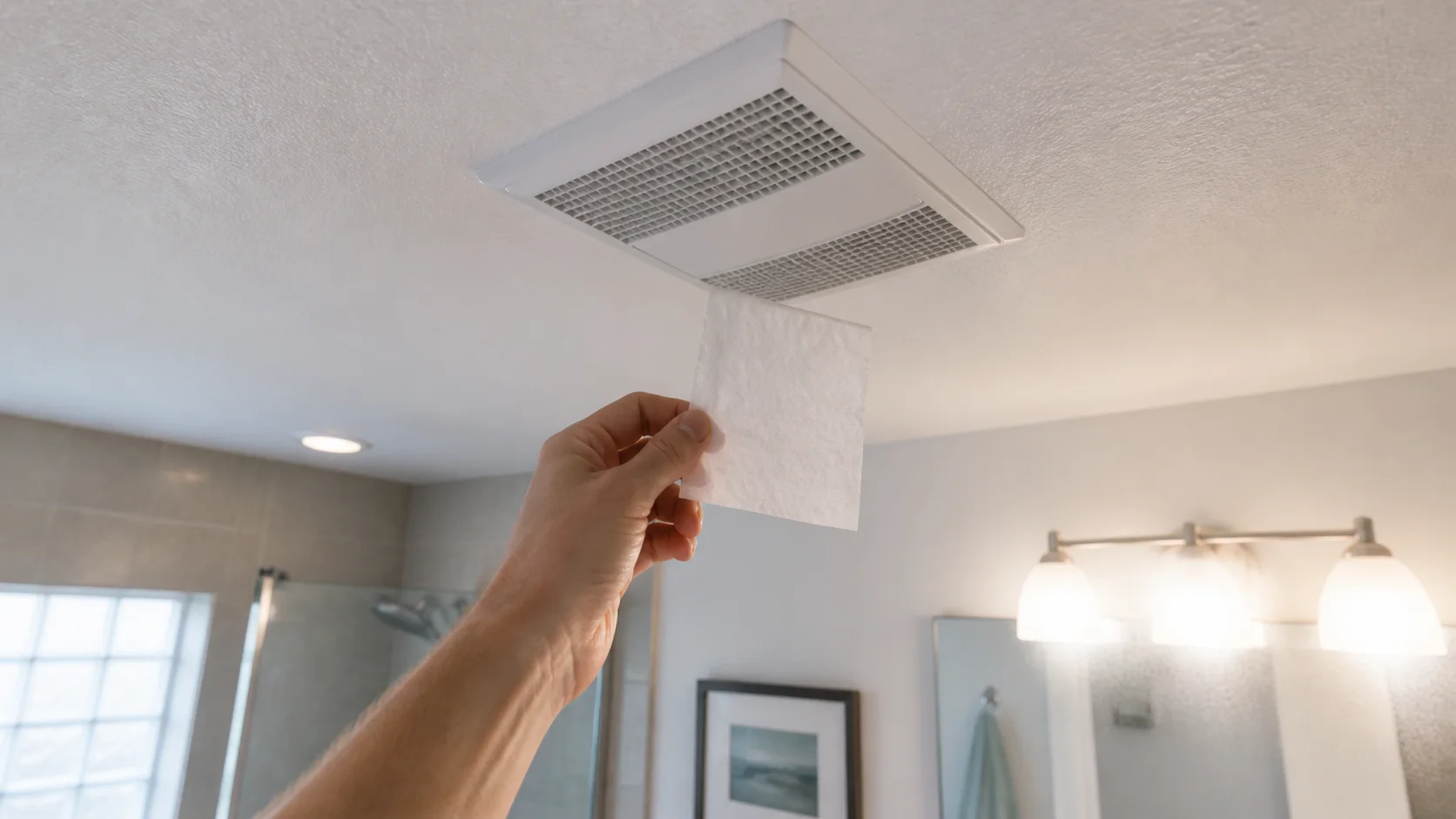
When I flip on a bathroom exhaust fan, I expect it to start pulling humid air out of the room. But sometimes the fan sounds completely normal while doing almost nothing. The motor hums, the blades appear to be spinning, and yet a piece of toilet paper barely sticks to the grille. After a shower, the mirror stays fogged and the room remains damp.
That is a strong clue that something is wrong with the airflow.
A bathroom fan does more than make noise. Its job is to pull moist air from the bathroom, move that air through a duct, and exhaust it outside the home. The U.S. Environmental Protection Agency specifically warns that simply hearing the motor run is not enough. A bathroom fan needs to exhaust a sufficient amount of air, and that air should go directly outdoors rather than into an attic or another enclosed area.
That makes a fan with little or no suction worth investigating. It belongs on the same early-action list as these home repairs that become expensive when ignored.
Here are the seven things I would check first.
| What I notice | Where I would start |
|---|---|
| Suction improves when the bathroom door opens | Check the replacement-air path and door clearance |
| Fan sounds normal but the outside damper stays closed | Inspect the damper and duct for blockage or disconnection |
| Fan starts slowly, grinds, rattles, or smells hot | Shut it off and inspect the motor or call a professional |
| Airflow has declined gradually over time | Clean the grille and blower before replacing the fan |
1. Check the Bathroom Fan Grille for Dust and Lint
I would begin with the easiest problem to see: a dirty grille.
The grille is the plastic or metal cover we see on the ceiling or wall. Because the fan continuously pulls bathroom air toward that opening, it also pulls in dust, lint, hair, tiny fibers, and other debris.
Over time, that material can build up across the slots in the grille.
The result is similar to trying to breathe through a piece of fabric. The fan motor may still run, but the opening becomes more restrictive, so less air reaches the fan.
I would turn the fan off and look closely at the grille. If I see a fuzzy layer of gray dust around the openings, cleaning it is an obvious first move.
Before removing the grille or reaching inside the unit, I would shut off power to the fan at the circuit breaker. Many bathroom fan covers are held in place with small spring clips, but designs differ, so following the manufacturer’s instructions is the safest approach.
Once the cover is removed, loose dust can often be vacuumed away. If the grille is washable, it can usually be cleaned separately and allowed to dry completely before being reinstalled.
I would also look just behind the grille. Dust can collect around the fan housing and blower assembly even when the outside cover does not look extremely dirty.
This simple cleaning step may restore noticeable airflow if the buildup was heavy.
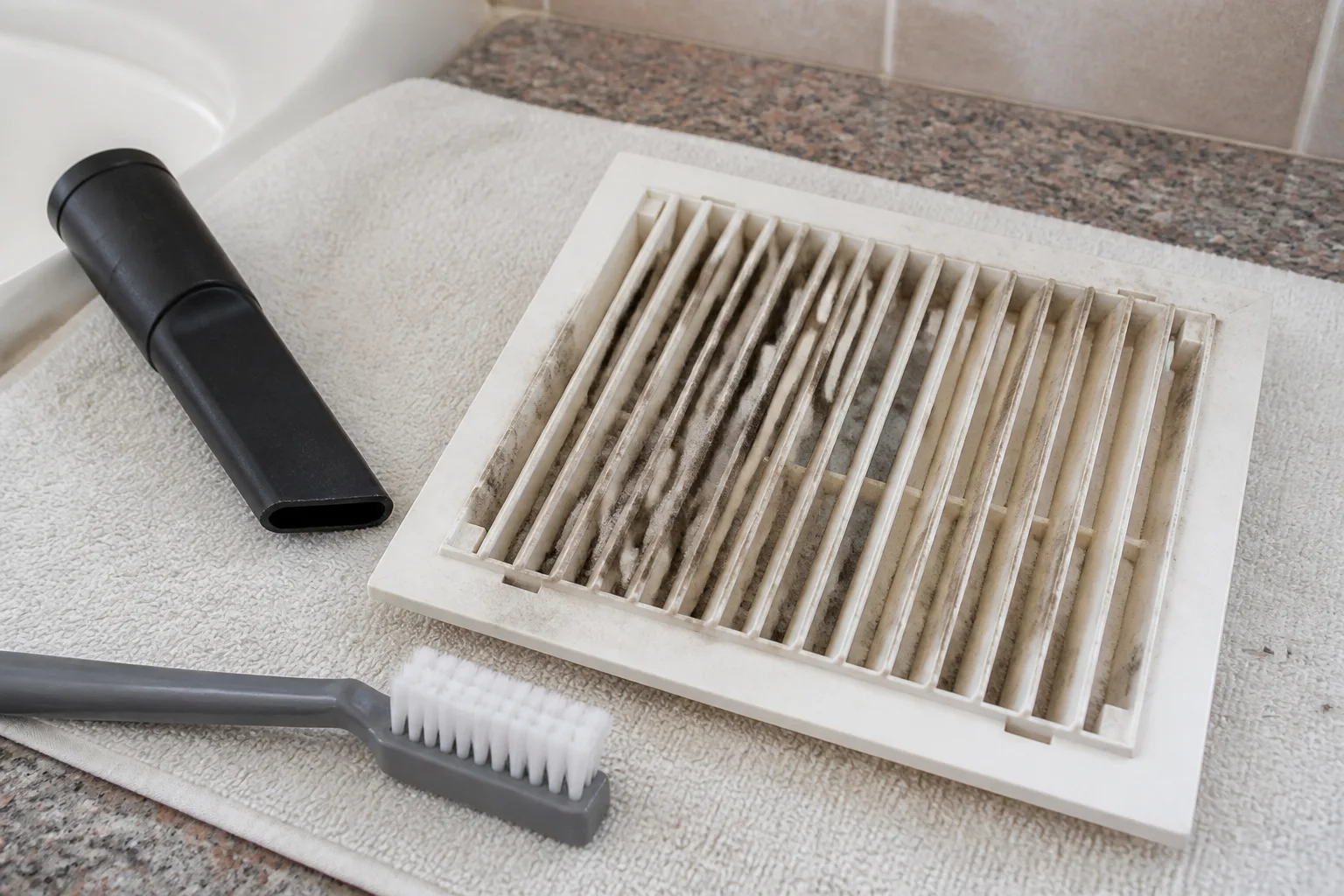
Even when it does not solve the entire problem, it eliminates one of the easiest possible causes before I start checking the duct or considering a replacement fan.
2. Inspect and Clean the Fan Blower
If the grille is clean but suction remains poor, I would look at the part that actually moves the air.
Bathroom exhaust fans use a rotating blower or fan wheel inside the housing. Depending on the design, it may look different from the familiar blades on a desk fan.
That blower can become coated with dust too.
This matters because the blades are shaped to move air efficiently. When dirt builds up on them, they may not grab and push air as effectively as they did when they were clean.
The motor can therefore keep spinning while actual airflow drops.
That is an important distinction. A running motor does not automatically mean a fan is working properly.
I would disconnect power before inspecting the inside of the unit. If the blower is accessible according to the manufacturer’s instructions, I would gently remove dust with a vacuum or appropriate cleaning method.
I would avoid spraying water or cleaner directly into an electric motor.
While looking inside, I would also check for anything obviously wrong with the blower. A cracked wheel, loose connection, unusual wobble, scraping noise, or damaged motor can reduce performance.
If the fan is making grinding, buzzing, or electrical noises, I would stop using it until the problem is identified. That is different from a simple airflow problem and may require professional repair or replacement.
3. Check the Backdraft Damper
A small flap can sometimes cause a surprisingly big airflow problem.
Bathroom exhaust systems commonly include a backdraft damper. Its job is simple: when the fan turns on, moving air pushes the damper open so humid bathroom air can escape. When the fan turns off, the damper closes to help prevent outdoor air from flowing backward through the duct.
If the damper becomes stuck, however, the fan can end up blowing against a closed door.
The motor still runs. The fan still makes noise. But very little air actually leaves.
I would check for a damper near the connection between the fan housing and the duct. I would also inspect the exterior termination point if it is safely accessible.
The Home Ventilating Institute recommends checking outdoor vent dampers to make sure they open when the fan is running and close when it is off.
Outdoor covers can become jammed by dirt, paint, corrosion, leaves, insects, or nesting material. A flap can also become bent or damaged.
One useful test is to have someone switch on the bathroom fan while I safely observe the exterior vent.
If the flap does not move at all, something may be restricting the airflow.
I would not climb onto a steep roof or place a ladder somewhere unsafe just to perform this check. If the bathroom vent exits through a difficult roof location, that inspection is better left to someone with the proper equipment.
4. Inspect the Exhaust Duct for a Blockage or Bad Connection
The duct may be the most important part of the system that homeowners rarely see.
The fan is only the beginning of the airflow path. Once it pulls air from the bathroom, that air needs a clear route through the duct and out of the house.
A problem anywhere along that route can dramatically reduce suction.
I would look for several common issues.
The duct may have come loose from the fan housing. Flexible ducting may be crushed between building materials. It may sag badly. It could contain sharp bends. A section might have collapsed. The duct may also be too narrow or too long for the fan.
Every restriction makes the fan work harder.
I think of it like drinking through a straw. A short, straight straw works easily. Pinch the straw in the middle, make it twice as long, and bend it around several corners, and moving anything through it becomes much harder.
The same basic idea applies to an exhaust duct.
HVI guidance shows that duct diameter, duct length, fittings, and turns can all affect ventilation performance.
I would pay special attention to flexible ducting because it can develop deep sags and tight bends.
Another major problem is a duct that does not actually reach the outdoors.
The EPA says bathroom exhaust fans should send moisture outside rather than into the attic or another enclosed part of the home.
Dumping warm, humid shower air into an attic simply moves the moisture problem somewhere else. In cold weather, that moisture can condense on colder building materials.
If I can safely see the duct from an attic or utility area, I would check that it remains connected from the fan all the way to an exterior vent.
A disconnected duct is a strong explanation for a fan that sounds powerful at the ceiling but does not seem to clear the bathroom.
5. See Whether the Bathroom Is Getting Enough Replacement Air
This is one of the easiest possibilities to overlook.
An exhaust fan removes air from a bathroom. But the air it removes has to be replaced by air coming from somewhere else.
If the bathroom is sealed too tightly, the fan may struggle.
I can test this in seconds.
First, I would close the bathroom door, turn on the exhaust fan, and check the suction at the grille with a light piece of toilet paper.
Then I would open the bathroom door several inches and test it again.
If the suction suddenly becomes much stronger with the door open, the fan may not be getting enough replacement air when the door is closed.
HVI says bathroom doors need enough clearance at the bottom to allow makeup air into the room. Its consumer guidance recommends at least about three-quarters of an inch of clearance between the door and finished floor.
Why does that matter?
Imagine trying to suck air out of a completely sealed box. As air leaves, pressure inside the box changes. Eventually, moving more air becomes difficult unless new air can enter.
A bathroom is not perfectly sealed, of course, but a tight door and a tightly constructed home can still restrict airflow enough to reduce fan performance.
This problem may be especially noticeable in newer homes that have been designed to limit unwanted air leakage.
The solution depends on the room and the building. Sometimes adequate door clearance is enough. Other homes may use transfer grilles or other ventilation strategies.
The important point is that I would test for the problem before blaming the fan.
6. Make Sure the Fan Is Powerful Enough for the Bathroom
A fan can be clean, properly connected, and fully operational but still feel weak simply because it is too small.
Bathroom exhaust fans are normally rated in CFM, which stands for cubic feet per minute.
That number tells us how much air the fan is designed to move under specified conditions.
The Home Ventilating Institute recommends at least 50 CFM for bathrooms smaller than 50 square feet. For bathrooms from 50 to 100 square feet, its guidance is roughly 1 CFM for every square foot of floor area.
So if I have an 8-foot-by-10-foot bathroom, the room contains 80 square feet of floor space.
Using the 1-CFM-per-square-foot guideline, I would want approximately an 80-CFM fan.
A 50-CFM unit could be undersized for that room.
Large bathrooms require another calculation. For spaces larger than 100 square feet, HVI recommends adding airflow based on the fixtures in the room:
- 50 CFM for a toilet
- 50 CFM for a shower
- 50 CFM for a bathtub
- 100 CFM for a jetted tub
That means a large bathroom with a toilet, shower, and bathtub could call for about 150 CFM under this guideline.
Ceiling height can matter too. HVI notes that bathrooms with ceilings higher than eight feet may need additional ventilation capacity.
I would check the fan label or model number to determine its rated airflow.
But I would also remember that the advertised CFM does not guarantee I am actually getting that much airflow at the grille.
Long ducts, narrow ducts, bends, dampers, and blockages all create resistance. A fan rated at a certain CFM under test conditions can deliver less airflow once installed in a restrictive real-world duct system.
That is why replacing a weak fan with a more powerful model will not always fix the problem if the real issue is a crushed or poorly designed duct.
7. Consider an Aging or Failing Fan Motor
If I have checked the cover, blower, damper, duct, replacement air, and fan size without finding the cause, I would start looking more closely at the fan itself.
Electric motors and blower assemblies do not last forever.
A motor can weaken with age. Bearings can wear. A blower wheel can loosen on its shaft. Plastic parts can crack. Internal components can deteriorate.
The confusing part is that the fan may continue to make noise.
That creates the impression that it is working normally.
But a motor that is spinning slowly or a loose blower wheel may move much less air than it once did.
I would pay attention to changes over time.
Does the fan sound slower than it used to?
Does it need several seconds to reach full speed?
Does it squeal, grind, rattle, or hum?
Does the blower wobble?
Does the motor become unusually hot?
Those signs suggest a mechanical or electrical problem rather than a dirty grille.
For an older basic fan, replacing the unit may make more sense than repairing the motor.
Newer ventilation fans can also offer features such as lower noise levels, humidity sensors, motion sensors, timers, and more efficient motors.
However, I would still verify the duct first. Installing an expensive new fan on a blocked duct will not magically restore airflow.
Why Weak Bathroom Fan Suction Matters
A bathroom fan is mainly a moisture-control device.
Every hot shower adds water vapor to the air. Some of that vapor eventually lands on cooler surfaces as condensation.
That is why mirrors fog.
But condensation can also form on ceilings, painted walls, windows, cabinets, and other surfaces.
If those materials stay damp repeatedly, the moisture may contribute to peeling paint, damaged drywall, swollen wood products, staining, and mold growth.
The EPA says moisture control is the key to controlling indoor mold and recommends using bathroom exhaust fans or opening windows when showering. The agency also recommends keeping indoor relative humidity below 60%, ideally between about 30% and 50%.
HVI says properly installed bathroom ventilation helps remove moisture, humidity, odors, and other pollutants while reducing deterioration of the home.
That is why I would not judge a fan by how loud it sounds.
I would judge it by whether it actually moves air.
Try the Toilet Paper Test — but Know Its Limits
One of the easiest airflow checks requires no special equipment.
I can switch on the fan and hold one square of lightweight toilet paper against the grille.
If the paper is pulled firmly against the grille, I know the fan is moving at least some air.
If it falls immediately, airflow may be very weak.
But this test has an important limitation.
It cannot tell me the actual CFM of the fan.
A fan might hold toilet paper against the grille and still deliver less airflow than the bathroom needs. Professional airflow measurements use specialized equipment to determine how much air is actually moving.
So I see the toilet paper test as an early troubleshooting clue rather than proof that the ventilation system meets its intended performance.
How Long Should I Run the Bathroom Fan?
Even a good fan needs enough time to remove lingering moisture.
HVI recommends leaving the bathroom fan running for about 20 minutes after using the bathroom. A timer switch can make this easier because I do not have to remember to return and shut the fan off.
That extra run time matters because the shower may be off while moisture is still evaporating from the walls, shower curtain, towels, tub, and other wet surfaces.
Turning the fan off the moment I leave the shower can stop ventilation too soon.
If a properly sized fan runs during the shower and for about 20 minutes afterward but the room remains extremely damp, that gives me even more reason to inspect the airflow system.
My Troubleshooting Order
I would not start by immediately buying a new exhaust fan.
Instead, I would work through the system from the simplest issue to the more complicated ones.
I would first test the suction and clean the grille.
Next, I would inspect the blower.
Then I would test the fan with the bathroom door open.
After that, I would see whether the exterior vent damper opens while the fan is running.
If the problem remains, I would inspect accessible ductwork for a disconnection, crushed section, excessive bend, or blockage.
Then I would compare the fan's CFM rating with the size of the bathroom.
Only after those checks would I assume the motor or fan assembly itself needs replacement.
That order can save money because a $0 cleaning job or a stuck damper should be identified before I spend money on a new fan. My guide to small home repairs that prevent bigger problems follows the same cheapest-safe-check-first logic.
When I Would Call a Professional
Some checks are simple homeowner maintenance. Others are not.
I would consider calling an electrician, HVAC professional, roofer, or qualified contractor if the fan trips a breaker, smells burned, produces sparks, has damaged wiring, or requires electrical changes.
I would also get professional help if the duct disappears behind finished walls, runs through an inaccessible attic, or terminates on a steep or difficult roof.
A professional airflow test can also be useful when everything appears normal but the bathroom still has persistent moisture problems.
I would never reach into an energized fan housing, work near exposed wiring, or climb onto an unsafe roof simply to diagnose a weak exhaust fan.
The Bottom Line
If my bathroom fan runs but has no suction, I would remember one basic rule:
Noise does not equal airflow.
The motor can run while a dirty grille restricts the intake.
The blower can spin while covered in dust.
A damper can remain stuck shut.
A duct can be crushed or disconnected.
A tightly closed bathroom can lack enough replacement air.
A fan can be too small for the room.
And an old motor can make plenty of noise while moving very little air.
The good news is that these possibilities can be checked in a logical order.
For me, the seven main things to inspect are:
- The fan grille
- The blower or fan wheel
- The backdraft damper
- The exhaust duct
- The bathroom's replacement-air path
- The fan's CFM rating
- The motor and overall fan condition
Finding the cause is worth the effort because bathroom ventilation is not just about clearing a foggy mirror. A properly working exhaust system helps move moisture outside, control indoor humidity, reduce condensation, and protect the materials inside the home.
If the fan is running but the bathroom still feels like a steam room, I would not assume everything is fine just because I can hear the motor.
I would check the airflow.
Official Sources
- U.S. EPA — Remodeling Your Home and Indoor Air Quality
- U.S. EPA — A Brief Guide to Mold, Moisture and Your Home
- U.S. EPA — Biological Contaminants and Indoor Air Quality
- Home Ventilating Institute — Bathroom Exhaust Fans
- Home Ventilating Institute — How Much Ventilation Do I Need?