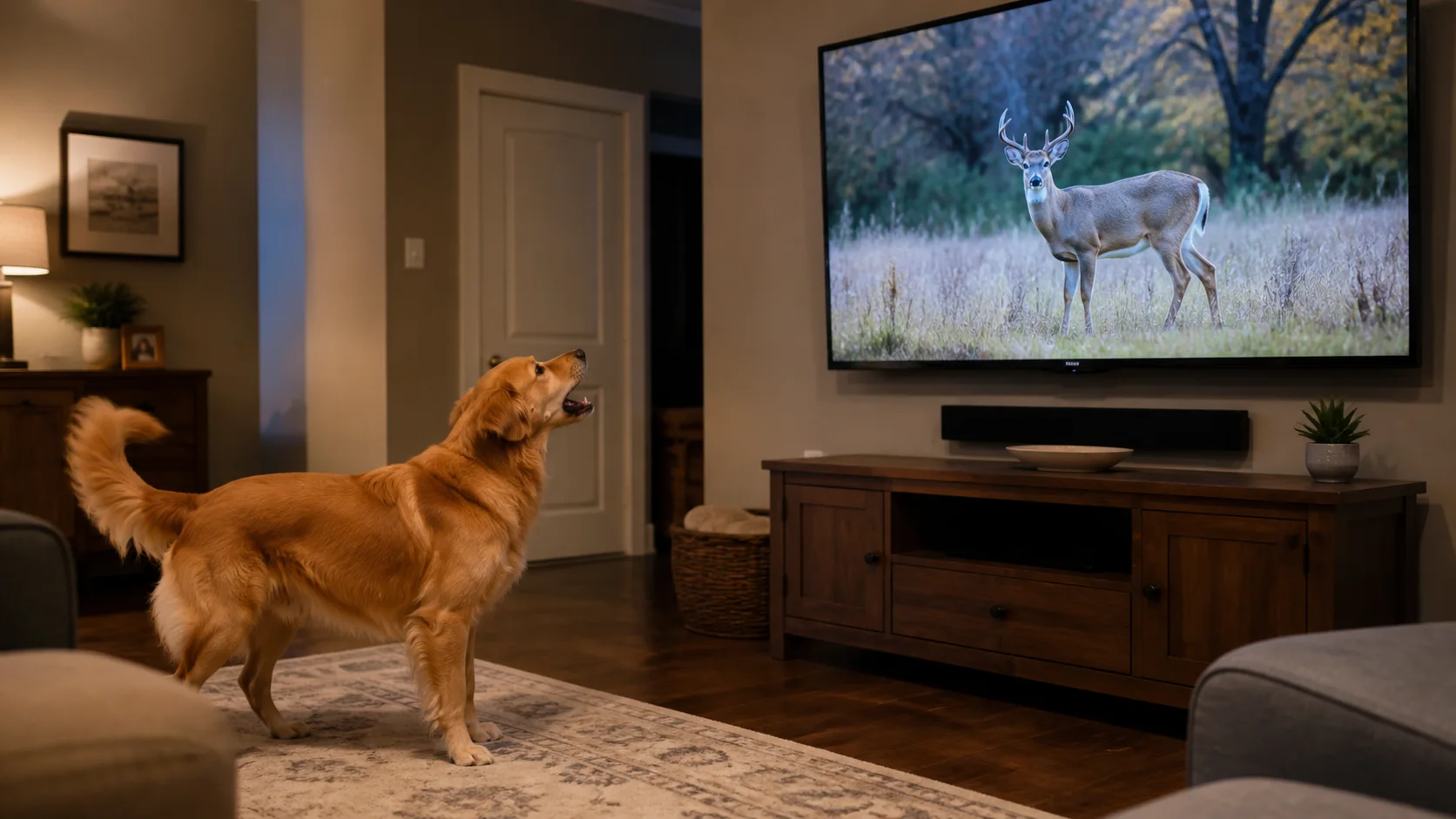
If my dog suddenly explodes into barking when a squirrel, horse, deer, cartoon dog, or other animal appears on television, I might wonder what is going through their head.
Do they think the animal is really in the room? Are they trying to protect the house? Are they excited? Are they scared?
The answer is that dogs really can notice and respond to animals on television, but different dogs react for different reasons.
Recent research gives us a much better picture of what is happening. A 2025 study published in Scientific Reports looked at television-viewing behavior reported for 453 dogs. Researchers found that dogs responded differently depending on what appeared on the screen, and animals were especially likely to get their attention. The study also found that personality mattered. More excitable and negatively reactive dogs showed different viewing behaviors than calmer dogs.
Recent dog-owner discussions show just how common—and strange—this behavior can seem. In one Reddit discussion, an owner explained that their dog barked whenever almost any four-legged animal appeared on TV. Other owners reported dogs reacting to ducks, deer, fish, cartoon animals, horses, insects, animal costumes, commercials, and even windshield wipers. One owner said their dog would jump onto the TV stand and bark at eye level with the television.
So this is not just one weird dog habit.
It is a real behavior problem many families are trying to solve.
The good news is that I usually do not need to yell, punish, or somehow convince my dog that the animal on TV is fake. A calmer approach is to reduce the intensity of the trigger, reward the behavior I want, and gradually teach my dog a new response.
Here is how I would do it.
Dogs Really Can Pay Attention to Television
I would begin with an important fact: dogs do not experience a television screen exactly the way humans do, but that does not mean they see nothing meaningful.
Researchers studying screen interaction in dogs have found that movement is a strong reason dogs pay attention to screens. Animal content is especially interesting, and images of dogs themselves appear to be particularly engaging. Dogs also commonly show excitement when reacting to screen content.
That means a dog running across the television can be much more interesting than a person sitting at a desk talking.
Sound matters too.
A dog may ignore a silent image but immediately look toward the TV when it hears barking, whining, hoofbeats, birds, squeaking, or another familiar animal sound.
Researchers in the 2025 television-viewing study even suggested that dogs can sometimes represent objects shown in two dimensions in ways that are meaningfully connected to real-world objects.
That does not necessarily mean my dog believes a full-size deer lives inside the television.
It means the picture and sound can be realistic enough to matter.
Why Does My Dog Bark at TV Animals?
There is no single reason.
For some dogs, barking appears to come from excitement.
The dog sees fast movement, becomes interested, and starts barking as part of the excitement. A dog with a strong interest in chasing moving things may become especially interested in wildlife or running animals on screen.
Other dogs may be frustrated.
They can see the animal but cannot reach it, smell it, or investigate it. The animal suddenly appears and disappears without behaving the way a real animal normally would.
Some dogs may be nervous or defensive.
If unfamiliar dogs already make my dog uncomfortable outdoors, a large dog suddenly appearing on a television screen and barking loudly could trigger a similar emotional response.
Personality appears to make a difference.
The 2025 study found that dogs rated as more excitable were more likely to show certain television-following behaviors. Negative reactivity was also connected with how dogs engaged with TV content.
That helps explain something many families notice: two dogs can live in the same house, watch the same television, and react completely differently.
One recent Reddit owner described exactly that situation. One dog watched and barked at animals and even recognized favorite pet-food commercials, while the other dog barely cared about the television at all.
Barking Can Become a Habit
There is another reason the behavior sometimes gets worse.
The dog practices it.
Imagine this sequence:
A deer appears.
My dog rushes toward the TV.
My dog barks.
Ten seconds later, the scene changes and the deer disappears.
From my dog's point of view, barking may appear to have worked.
“I barked, and the deer went away.”
The dog does not have to understand television for that pattern to become stronger.
If it happens again and again, rushing toward the television can turn into an automatic habit.
That is why management is so important.
Every evening that my dog spends barking at a wildlife show for 30 minutes is another evening of practice.
Training becomes easier when I reduce that uncontrolled practice.
First, I Watch My Dog’s Body Language
Before trying to stop the barking, I want to understand what the dog is feeling.
An excited dog may have a loose body, wagging tail, bouncing movements, and eager behavior.
A worried dog may become stiff.
The ears may change position.
The dog might stare intensely, growl, back away, raise its hackles, or suddenly rush forward.
A highly frustrated dog may pace, whine, bark repeatedly, scratch near the television, or search behind the screen.
The dog's emotional state matters because training is much easier when the dog is still able to think. My guide to overlooked signs of stress in dogs can help identify the quieter signals that appear before an outburst.
Behavior trainers sometimes describe this using the idea of a threshold.
Below threshold, my dog notices the trigger but can still respond to me.
Above threshold, my dog becomes so excited, fearful, or frustrated that responding becomes difficult.
One easy clue is food.
If my dog normally loves chicken but will not even turn their head for chicken while an animal is on TV, the training situation is probably too difficult.
I do not need a better command.
I need an easier setup.
My Goal Is Not Simply “Stop Barking”
This is one of the biggest changes I would make.
Instead of thinking:
How do I make my dog stop barking?
I would ask:
What do I want my dog to do when an animal appears?
That question gives me something I can actually train.
Maybe I want the dog to look at the animal and then look back at me.
Maybe I want the dog to remain on a bed.
Maybe I want the dog to hear barking from the television and calmly continue chewing a toy.
Maybe I want the dog to walk away from the television when I say, “Come.”
Those are clear behaviors.
“Don't bark” is much less clear from the dog's point of view.
Step 1: Make the Trigger Much Easier
I would not begin training by turning on a loud nature documentary filled with running wolves.
I would start with the easiest version of the problem I can create.
For example, I might:
- Lower the television volume.
- Sit farther away from the screen.
- Use a small animal on screen instead of a close-up.
- Start with a calm animal instead of one running.
- Use a very short clip.
- Pause the screen before the dog becomes excited.
My goal is to let the dog notice the trigger without exploding.
This process is known as desensitization.
Veterinary behavior guidance from VCA Animal Hospitals describes desensitization as carefully exposing an animal to a trigger at a low enough level that it does not produce fear or stress. The intensity is then increased gradually as the animal remains comfortable.
That word “gradually” matters.
If my dog normally starts barking the second a dog fills the entire television screen, starting there is probably too difficult.
Training does not need to look dramatic to work.
In fact, boring training can be excellent training.
Step 2: Make Animals on TV Predict Something Good
Next, I would change what the appearance of the television animal means.
I would prepare tiny pieces of something my dog really likes.
Maybe that is chicken, cheese, turkey, or another dog-safe high-value reward.
Then:
Animal appears.
Treats happen.
Animal disappears.
Treats stop.
At first, I am not even asking for a complicated behavior.
I am creating a new connection.
Instead of:
TV animal = bark!
I want:
TV animal = something good happens.
This technique is called counterconditioning.
VCA describes counterconditioning as pairing something that causes a negative emotional response with something that creates a positive emotional response. Desensitization and counterconditioning are commonly used together.
This matters because sometimes barking is not just a command problem.
It is an emotional problem.
If the dog feels worried or wildly excited, simply demanding silence may not change that feeling.
Counterconditioning is designed to work on the feeling underneath the behavior.
Step 3: Reward the Moment My Dog Looks Away
Once my dog can watch an easy animal scene without immediately barking, I would start watching for something extremely important:
The moment the dog voluntarily looks away.
Suppose a dog appears on television.
My dog looks at it.
Then my dog turns toward me.
That is the moment I want.
I can calmly say “yes” or use another marker word and immediately reward the dog.
Over time, I am trying to create this habit:
Animal appears → notice animal → look at me → get rewarded.

That pattern can eventually replace:
Animal appears → charge television → bark repeatedly.
At the beginning, I might help by saying my dog's name once.
But I would avoid repeating:
“Buddy! Buddy! Buddy! Buddy!”
If the dog cannot turn around after one easy cue, that usually tells me the trigger is too intense.
I would make the exercise easier instead.
Step 4: Teach a Mat Behavior
For dogs that physically rush toward the television, I really like teaching a separate relaxation station.
This could be:
- A dog bed.
- A mat.
- A folded blanket.
- A specific spot beside the couch.
I would teach this behavior when the television is not showing animals.
First, I reward the dog for stepping onto the mat.
Then for staying.
Then for lying down.
Then for relaxing there while normal television plays.
Only after the dog understands the mat would I begin adding easier animal scenes.
Eventually, the pattern might become:
Animal appears → dog goes to mat → reward.

This gives the dog a clear job. The same calm, reward-based approach also helps when teaching a dog not to jump on guests.
That is usually much easier to understand than simply hearing “NO!” from across the room.
Step 5: Keep Training Sessions Short
I would resist the urge to practice for an entire television episode.
Three good minutes can be enough.
I might show an animal briefly five times, reward five successful calm responses, and stop.
That is a successful training session.
Tomorrow, I can do it again.
A dog does not need to become exhausted for learning to happen.
In fact, continuing until the dog finally loses control can make the session less useful.
Desensitization works because the dog remains at a manageable level of intensity.
The ASPCA warns that desensitization and counterconditioning can backfire if an animal becomes frightened during the process. When significant fear is involved, professional guidance may be necessary.
Step 6: Increase Only One Difficulty at a Time
Once the dog succeeds consistently, I can slowly make the situation harder.
Maybe I increase the volume.
But I keep the animal far away on screen.
Later, I use a larger animal image.
But I lower the volume again.
Later, I introduce faster movement.
I would avoid changing everything at once.
If yesterday's lesson was a quiet dog sitting calmly in the distance and today's lesson is a pack of barking wolves running toward the camera at full volume, I have skipped several steps.
If barking returns, I would not label the dog stubborn.
I would simply say:
That step was too hard.
Then I would make the next repetition easier.
What If My Dog Suddenly Barks During a Normal Show?
Real television is unpredictable.
I might be watching a drama when suddenly a dog appears.
Or a commercial might start with loud barking.
If my dog reacts, I would avoid shouting along with them.
Instead, I would calmly try to create distance from the television.
If the dog knows a simple cue such as “come,” “touch,” or “mat,” I can use it.
Then I reward the dog when they disengage.
If the dog cannot respond at all, I would simply make the trigger disappear or become weaker.
Mute the TV.
Change the channel.
Block the dog's view.
Move farther away.
The important question is not:
Can I force my dog to obey while they are completely overwhelmed?
It is:
Can I get my dog back into a state where learning is possible?
Why I Would Avoid Yelling
I understand why people yell.
The dog is barking.
The television is loud.
Everyone is annoyed.
“STOP!”
But adding more noise to an already excited situation may not help.
The dog may simply hear another person making loud noises.
Yelling can also turn the appearance of TV animals into an even more unpleasant event.
Animal appears.
Dog gets tense.
Owner gets angry.
Everyone becomes louder.
That is the opposite of the calm association I want to build.
I would also avoid physical punishment.
The recent Reddit thread included one suggestion involving physically startling or pinching the dog while barking. That is a good example of why online advice should be evaluated carefully rather than followed automatically.
For a dog that is already worried or overexcited, adding pain or intimidation can create another negative association with the trigger.
Gradual exposure and reward-based counterconditioning have a much clearer connection to established veterinary behavior guidance, including the American Veterinary Society of Animal Behavior position on humane dog training.
What If Treats Don’t Work?
This is one of the most common frustrations.
“My dog doesn't care about treats when the animal is on television.”
That actually tells me something useful.
If the dog normally loves those treats but suddenly cannot eat them, the dog may already be too aroused.
I would lower the difficulty.
I might:
- Move farther from the TV.
- Turn down the volume.
- Use a still picture.
- Show the trigger for only one second.
- Pick a less exciting animal.
- Use higher-value food.
- Practice when the dog is already relaxed.
Interestingly, the recent Reddit discussion included exactly this problem. The original poster said the dog became so focused on the television that regular treats were not enough. Other commenters suggested trying much more valuable rewards.
Reddit comments are personal experiences rather than scientific evidence, but in this case the idea fits a basic training principle: the reward has to be valuable enough for the situation.
Management Is Part of the Training Plan
Sometimes I want to watch television.
I do not want every evening to become a dog-training class.
That is where management comes in.
If I know I am watching a wildlife documentary and my dog is nowhere near ready for that challenge, I can prevent the problem instead.
Maybe the dog gets a stuffed food toy in another room.
Maybe I use a gate.
Maybe the dog relaxes in a different part of the house.
Maybe I lower the volume.
Preventing barking practice is useful because habits become stronger through repetition.
Management is not giving up on training.
It protects the training.
Secure the Television
There is also a safety issue owners should not ignore.
One person in the recent Reddit discussion said their dog jumps onto the TV stand with its front paws and barks directly at the screen. The owner worried the dog could knock the television over.
That is a reasonable concern.
A dog charging a television can injure itself even if the barking itself is harmless.
If my dog physically hits furniture around the television, I would secure the TV or mount it safely and prevent access to the stand while I work on training.
Training takes time.
Safety measures should happen immediately.
A Simple Seven-Day Starter Plan
If I wanted to begin working on television barking this week, here is the plan I would use.
Day 1: Find the Triggers
I would make a quick list.
Does my dog react to:
Dogs?
Cats?
Horses?
Wild animals?
Animal sounds?
Fast movement?
Cartoons?
Large animals but not small ones?
Understanding the trigger makes training much easier.
Day 2: Teach an Alternative Behavior
With the television trigger absent, I would practice something simple.
“Look.”
“Touch.”
“Come.”
“Mat.”
I want the behavior to be easy before I need it around television animals.
Day 3: Introduce an Easy TV Animal
I would show a calm animal at low intensity.
The dog notices it.
I reward calm behavior.
The session lasts only a few minutes.
Day 4: Repeat
I would repeat several short sessions instead of making the exercise harder immediately.
Repetition builds the new pattern.
Day 5: Reward Looking Away
Now I specifically watch for my dog to notice the screen and then look back toward me.
That earns the best reward.
Day 6: Make One Thing Harder
I might slightly increase the volume.
Or add a little more movement.
Not both.
If barking begins repeatedly, I go back to yesterday's easier level.
Day 7: Try a Small Real-World Test
I would play normal television for a short period.
When an animal appears, I use the behavior we have practiced.
Then I reward calm disengagement.
I would stop before my dog becomes exhausted or overwhelmed.
What Recent Dog Owners Are Reporting
The online discussion around TV barking is useful because it shows how different dogs can be.
One dog may bark at every animal.
Another only reacts to horses.
Another recognizes the jingle from pet-food commercials.
Another reacts to cartoon animals.
Another seems bothered mainly by barking sounds.
Another dog in the same house may completely ignore everything.
One Reddit owner even reported that their dog reacted strongly to television animals but did not respond the same way to animals on a phone screen.
Scientific research points in the same general direction.
Dogs appear to differ greatly in their screen engagement, and personality, movement, and the type of content shown can influence their behavior.
That is why there is no perfect one-size-fits-all training schedule.
I have to train the dog in front of me.
When I Would Call a Professional
Mild television barking is often something families can work on with careful training.
But some reactions are bigger than a simple nuisance.
I would seek professional help if my dog:
- Repeatedly throws their body at the television.
- Redirects aggression toward people or pets.
- Seems terrified rather than merely excited.
- Cannot recover long after the animal disappears.
- Reacts intensely to many ordinary sights and sounds.
- Cannot stay below threshold even with very easy exposure.
The ASPCA notes that desensitization and counterconditioning can be difficult to carry out correctly and recommends professional guidance for significant fear problems. Options may include a Certified Applied Animal Behaviorist, a board-certified veterinary behaviorist, or an appropriately experienced professional dog trainer.
I would also talk with my veterinarian if the behavior begins suddenly or changes dramatically. If the dog also becomes unusually clingy away from the television, this guide explains why dogs follow their owners everywhere and when that change deserves attention.
Unexpected behavior changes can sometimes be connected to pain, illness, sensory changes, or another medical issue.
The Bottom Line
If my dog barks at animals on television, the first thing I would remember is that the reaction is not as strange as it looks.
Dogs really do pay attention to screen content.
Animals and movement can be especially interesting, and scientific research suggests that personality influences how strongly individual dogs engage with television.
I would not try to win a shouting match with my dog.
Instead, I would make the trigger easier.
I would reward calm observation.
I would teach the dog to look back at me or go to a mat.
I would increase the challenge slowly.
And when I am not training, I would prevent the dog from spending another hour practicing the barking habit.
The first signs of success may be small.
Maybe the dog used to bark for 30 seconds and now stops after five.
Maybe the dog sees a horse and looks back at me before barking.
Maybe the dog stays on the mat through one commercial.
Those moments matter.
They are the beginning of a different habit.
With enough calm repetition, an animal appearing on television can stop being a household emergency and become something my dog notices—and then lets go.
Official Sources
2025 Scientific Reports study: Characterizing TV viewing habits in companion dogs
VCA Animal Hospitals: Desensitization and Counterconditioning
ASPCA guidance on desensitization and counterconditioning
Recent Reddit discussion: Dogs barking at animals on the TV
Older competing Cuteness guide: Why Do Dogs Bark at Animals on TV?